

We grew up thinking the internet was just for email and browsing. Then came the era of swapping everything. Music. Movies. Games. It felt like magic. Napster started it all in the late ’90s. Millions of users traded MP3s until the music industry sued them into oblivion. Napster folded, then reinvented itself as a legal store. But the genie was out of the bottle.
Kazaa arrived a few years later. It wasn’t just about music. It was everything. Movies. TV shows. Software. It became the dominant force in peer-to-peer (P2P) file sharing. The question wasn’t if you could share files. It was how much you could get away with.
The Rise and Fall of Niklas Zennström
Kazaa launched in March 2001. The creators were Niklas Zennström and Janus Friis. They were based in the Netherlands at a company called Consumer Empowerment. They built an open forum. Users could share what they made. They could also share what they downloaded. This distinction didn’t matter to the courts.
In 2001, the American music labels and movie studios struck back. Copyright infringement lawsuits flew. The pressure was immense. Zennström and Friis didn’t fight it in the US courts. They shut down their operations. They transferred ownership to Sharman Networks Limited. That company was based in the South Pacific, far from the reach of the Recording Industry Association of America (RIAA).
Despite the legal storm, Kazaa remained huge. It became a thriving business with millions of active users.
What You Could Actually Do With Kazaa
Downloading the software was free. The interface let you do a lot. You could search for movies, music, and TV shows. You could also pull content from other providers on the internet. The search results were massive. You could get up to 3,000 results per query.
The download process was aggressive. It pulled files simultaneously from several sources. This meant faster speeds. It also meant you could promote your own content to other users.
The Numbers Behind the Network
Kazaa was one of the most popular P2P networks on the internet at its peak. The scale was staggering. On any given day, roughly 3 million users were active. They were sharing upwards of 800 million files. That is a lot of data moving through nodes. It created a network that was difficult to shut down.
Blue Files vs. Gold Files
Searching for a file was straightforward. You typed the name. You hit search. You selected a file from the list. But the files themselves were different. Kazaa categorized them by color and control.
-
Blue files were user-controlled. These were content made by Kazaa users. Creators could license this content. If they did, others couldn’t copy or distribute it without credit. These files were free to download.
-
Gold files were different. These contained content from movie studios and music labels. The providers oversaw the use of the material. These files were distributed via another P2P network called Altnet. They were pay-per-download.
Kazaa made money in a few ways. Online ads were a big part of it. They also distributed special “Rights Managed” content, which used the gold icon. Selling products and services added to the revenue. The core software remained free.
How Does Kazaa Work?
The magic of Kazaa was in its architecture. It didn’t rely on a central server to store files. That was the key to its survival. When a user searched for a file, the software queried the network. It found other users who had that file. It connected you directly to them.
This is called a decentralized network. There was no single point of failure. If one server went down, the others kept working. The data lived on the hard drives of millions of people. To shut it down, you’d have to shut down every computer on the internet. That wasn’t happening.
The RIAA sued Sharman Networks. They argued the service was designed for infringement. The defense argued it was just a tool. A hammer can build a house or break a window. The legal battle dragged on. Kazaa weathered the storm. It survived the initial wave of lawsuits that had taken down Napster.
Why did it survive? The decentralized structure made it hard to pin liability on a single entity. The transfer to Sharman Networks in the South Pacific added another layer of protection. The legal teams in the US had to navigate international jurisdictions. It bought time. Time that Kazaa used to grow its user base.
The user experience was simple. You clicked. You waited. You got the file. No one asked who you were. The network didn’t care. It only cared that the data moved.
This setup changed how people thought about ownership. You didn’t own the file. You just had a copy. The original remained with the studio or the creator. But for the user, it didn’t matter. The file played. The movie watched. The game installed.
The legal pressure never fully disappeared. It just shifted. New lawsuits emerged. New laws were proposed. But the technology had already spread. The precedent was set. Peer-to-peer sharing was here to stay.
Kazaa showed that you could build a massive network without owning the content. You just needed the users. And people loved the idea of free access. It was a thrill. It was risky. But it was powerful.
The battle between control and distribution continues. It just looks different now. Streaming services own everything. But the underlying desire for access remains. The tools have changed. The network has shifted. The core question is the same. Who owns the digital world?
We don’t have a final answer. The servers keep running. The files keep moving. The network persists.
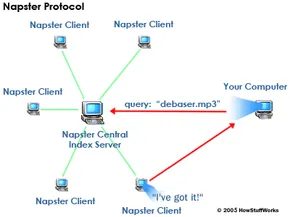
Why Kazaa’s Architecture Survived the Legal Storm
Kazaa rode the same peer-to-peer (P2P) wave that made Napster a household name. But the underlying mechanics were entirely different.
Napster relied on a centralized server. It acted as a middleman, indexing files and directing traffic. Kazaa abandoned that model. It uses a decentralized system. Users connect directly to one another. There is no central hub to shut down.
This structural difference is why Kazaa stayed online while its predecessor faced a court order. The lack of a single point of failure made it incredibly difficult for copyright holders to trace the source or dismantle the network.
The Decentralized Advantage Explained
When you use a P2P network like Kazaa, your computer isn’t just downloading. It’s uploading too. Every user becomes a node in the web.
“Kazaa’s decentralization is one of the main reasons why it has weathered the legal firestorm this long.”
This setup creates a resilient network. If one user goes offline, the file remains available through others. Legal teams couldn’t just sue a company server. They had to fight a hydra. Cut off one head, and two more appeared.
How Centralized vs. Decentralized P2P Differs
The distinction between centralized and decentralized models defined the fate of early file-sharing giants.
Napster (Centralized):
– Server indexes all available files.
– User searches the server.
– Server directs the download.
– Single point of failure. Shut the server, kill the network.
Kazaa (Decentralized):
– Users connect peer-to-peer.
– No central index.
– Clients share chunks of files with each other.
– Distributed control. Hard to legally target.
This architecture allowed Kazaa to persist in the shadows of the law. It wasn’t just a tool. It was a movement built on code that refused to sit still for a subpoena.
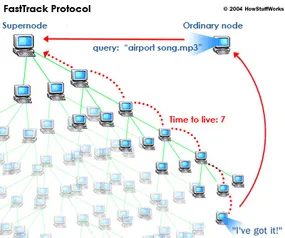
How Kazaa’s Supernode Network Functioned
The backbone of Kazaa wasn’t magic. It was FastTrack, a “second-generation” peer-to-peer protocol that split the user base into two distinct roles. You had supernodes and ordinary nodes.
Supernodes were the heavy lifters. These were powerful computers with fast connections, high bandwidth, and quick processing power. Here is the kicker: computer owners often didn’t know their machines had been designated as supernodes. Roughly 30,000 of these nodes acted as traffic hubs. Each supernode could handle between 60 and 150 ordinary nodes simultaneously.
When you installed Kazaa, the software came pre-coded with a list of supernodes. Every time you launched the app, your computer registered with a central server, then picked an active supernode from that list.
“Once the correct file has been located, it is transferred directly from the file owner to the requester using HTTP… it doesn’t have to go through a supernode.”
Your download requests were funneled through the supernode. The supernode talked to other supernodes, which connected to regular nodes, which connected to even more regular nodes. This chain continued until the Time to Live of 7 ran out. That search request extended seven levels into the network before stopping.
Once the file was found, the transfer happened directly between the owner and the requester via HTTP. The supernode stepped out of the way.
Kazaa-Esque Clones and DMCA Backlash
Kazaa’s success spawned a wave of unofficial clones. Programmers and companies wanted a piece of the action. They built their own versions of the file-sharing software, often claiming to strip out adware and spyware while adding new features.
Popular rip-offs included:
– Kazaa Lite Resurrection
– Kazaagold
– Kazaa Lite Tools K++
– Diet K
Kazaa didn’t take this lying down. The company viewed these copies as copyright infringers. In 2003, they filed a complaint under the Digital Millennium Copyright Act (DMCA) demanding that all infringing sites be removed from the Internet.
Is Kazaa Legal?
Like Napster before it, Kazaa allowed users to exchange copyrighted material without paying royalties. The company claimed to be “completely legal,” but many disagreed. The blue files available for free download were controlled by users and frequently contained copyrighted content.
Movie studios and record labels filed infringement lawsuits against Kazaa itself. They also sued individual Kazaa users.
In 2001, a Dutch music company sued Kazaa. They were ordered to stop users from violating copyrights or face steep penalties. Kazaa responded by transferring ownership to offshore companies, primarily Sharman Networks Limited on the island of Vanuatu.
But the legal battle didn’t end there. In 2002, a Dutch appeals court overturned the previous judgment. They ruled that Kazaa was not responsible for its users’ actions. The decentralized structure meant Kazaa wasn’t involved in the actual file sharing. All searches and downloads occurred directly between user computers.
Later that year, Kazaa faced suits in the United States from the Recording Industry Association of America (RIAA) and the Motion Picture Association (MPAA). As of February 2005, the decision in that suit was still pending.
Kazaa’s defense—that its decentralized setup freed it from liability—got a boost in 2003. A U.S. District Court judge ruled that Grokster and Morpheus, two other file-sharing services, were not liable for their users’ actions either.
This left only the users themselves liable.
RIAA Targets Individual Users
The Recording Industry Association of America (RIAA) started targeting individual users in 2003. They didn’t go after everyone. They zeroed in on people who had made thousands of copyrighted files available to others.
These repeat file sharers were identified by their IP addresses. They hit with lawsuits ranging from $750 to $150,000.
In October 2004, the International Federation of the Phonographic Industry (IFPI) launched similar lawsuits against several hundred users of Kazaa and two other file-sharing services.
Polluted Music Files
The music industry wasn’t just fighting in court. They were fighting on the network.
In 2003, the music industry lost an estimated $300 million in CD sales to P2P services like Kazaa. They fought back with lawsuits. But they also launched an unconventional attack: they sabotaged their own material.
Record companies “polluted” Kazaa by creating fake versions of songs. They distributed these fakes on the network.
Here is how it worked:
1. The song played correctly for the first 10 seconds.
2. The remainder of the track consisted of a repeated “blipping” noise.
Unsuspecting users downloaded the fake songs and distributed them to others. The number of fake copies circulating multiplied. Often, it exceeded the number of real copies.
The goal was simple. Frustrate Kazaa users to the point where they abandoned the system and purchased the song instead.
It’s a strange legacy. A protocol designed to distribute content freely ended up distributing noise. And the network structure that protected the platform from liability became the very thing that allowed users to be tracked, sued, and eventually, bored into compliance.
The supernodes are gone. The clones have faded. But the question of how we move data between peers without a central gatekeeper remains. We still use similar architectures today. We just call them something else.
The Privacy and Security Reality of Early P2P
You think you’re just sharing a song. You’re actually handing over your digital keys.
When you let other computers pull data from yours—or you do the pulling—you are cracking open the door. The wind blows in viruses. It blows in privacy invasions. It blows in a host of security issues that don’t care about your playlist.
Kazaa wasn’t just a file-sharing tool. It was a Trojan horse with a user interface.
The software was frequently accused of installing spyware and adware on user machines. This wasn’t passive background noise. The code monitored your movements across the web. It downloaded ads directly to your hard drive without your knowledge. You didn’t ask for them. You didn’t want them. But they were there.
The old versions of the software came bundled with this malicious code. The removal process was complicated. You had to dig through the download options. Most people missed the fine print. They accepted the spyware by accident.
Today, the company behind the software asserts that it no longer collects or uses personal information about its users. That’s the official line.
Copycat versions claimed to fix this. Kazaagold. Kazaa Lite Tools K++. They promised software free from adware and spyware. Promises are cheap. Code is what matters.
To stop sensitive information from leaking out, Kazaa gave users a specific instruction. Set up a “My Shared Files” folder on the desktop. Just one folder.
When people tried to download a file, they could only access that shared folder. They couldn’t wander freely across the individual’s hard drive. This was a containment strategy. It wasn’t a cure. It was a bandage on a bullet wound.
The software also came equipped with virus-protection software. It weeded out some of the bugs floating around cyberspace. Some bugs. Not all of them. The internet is a wild place.
The tension between convenience and security is the defining feature of peer-to-peer networks.
The Legal Battle for KaZaA
Was it legal? The answer depends on where you stand and which judge is listening.
The history of KaZaA is a history of lawsuits. The music industry didn’t take this lying down. They sued.
- The Hoya: RIAA Steps Up Student Lawsuits. The trial was set for February 1, 2005.
- CNN.com: Makers of Kazaa suing record labels. This happened in September 2003.
- Newsbytes: Kazaa Creators Say Lawsuits Too Costly To Continue. May 23, 2002.
- afterdawn.com: Dutch appeals court ruled KaZaA is legal. March 28, 2002.
- WiredNews: Kazaa Halts Download Distribution. January 18, 2002.
- The Register: KaZaA ordered to cease infringing copyright. November 29, 2001.
There is no definitive answer to the legality question. It depends on the country. It depends on copyright laws. In general, downloading copyrighted material without permission is illegal. But the technology itself? That’s a gray area.
KaZaA was a file-sharing service popular in the early 2000s. It allowed users to share music, videos, and other files. It came with adware. It came with spyware. It came with malware.
Why did it shut down? There is no single answer. Theories abound. Some say it was pressure from the music industry. Others say Sharman Networks just decided to end it. The service is no longer in operation.
Why This Matters Now
We look back at KaZaA and see a relic. A piece of internet history.
But the issues remain. Privacy. Security. The right to share data. The right to protect data.
The “My Shared Files” folder is still a good practice. Isolate your shared assets. Don’t give strangers access to your entire drive.
Virus protection is still necessary. It always has been.
The legal landscape has shifted, but the core conflict hasn’t. Content creators want control. Users want access. The technology sits in the middle, often broken, always evolving.
If you want to understand how this happened, you have to look at the underlying mechanics.
Related Topics
- How File Sharing Works
- How Home Networking Works
- How Music Licensing Works
- How the Old Napster Worked
Further Reading and Sources
For those digging into the technical details:
- Kazaa
- ShareTheFiles.com
- SpywareInfo: Clean and Infected File Sharing Programs
- Slyck’s Guide to FastTrack
Books that provide context:
- Sonic Boom: Napster, MP3, and the New Pioneers of Music by John Alderman
- Discovering P2P by Michael Miller
- Peer-to-Peer: Harnessing the Power of Disruptive Technologies by Andy Oram
- Steal This File-Sharing Book by Wallace Wang
- MP3 Underground: The Inside Guide to MP3 Music, Napster, RealJukebox, MusicMatch, and Hidden Internet Songs by Ron White
Sources from the era of the lawsuits:
- “459 European P2P users sued.” AfterDawn.com, October 7, 2004.
- Corder, Mike. “Recording Industry and File-Sharing Service Face Off in Australia,” The America’s Intelligence Wire, November 29, 2004.
- Evers, Joris. “Dutch Supreme Court Rules Kazaa Legal,” PCWorld, December 19, 2003.
- “FastTrack,” Free-Definition.
- “Kazaa Owner Complains of Copyright Infringement,” Chilling Effects.
- Liang, Jian, et al. “The KaZaA Overlay: A Measurement Study,” Polytechnic University, New York, September 15, 2004.
- Liang, Jian, et al. “Pollution in P2P File Sharing Systems,” Polytechnic University, New York.
- Napster’s Sons: Singing a Different Tune?” Business Week Online, February 21, 2002.
- “Sued for a Song,” What’s the Download.com.
- Woody, Todd. “The Race to Kill Kazaa.” Wired, Issue 11.02, February 2003.
The trail doesn’t end here. It just changes direction.