
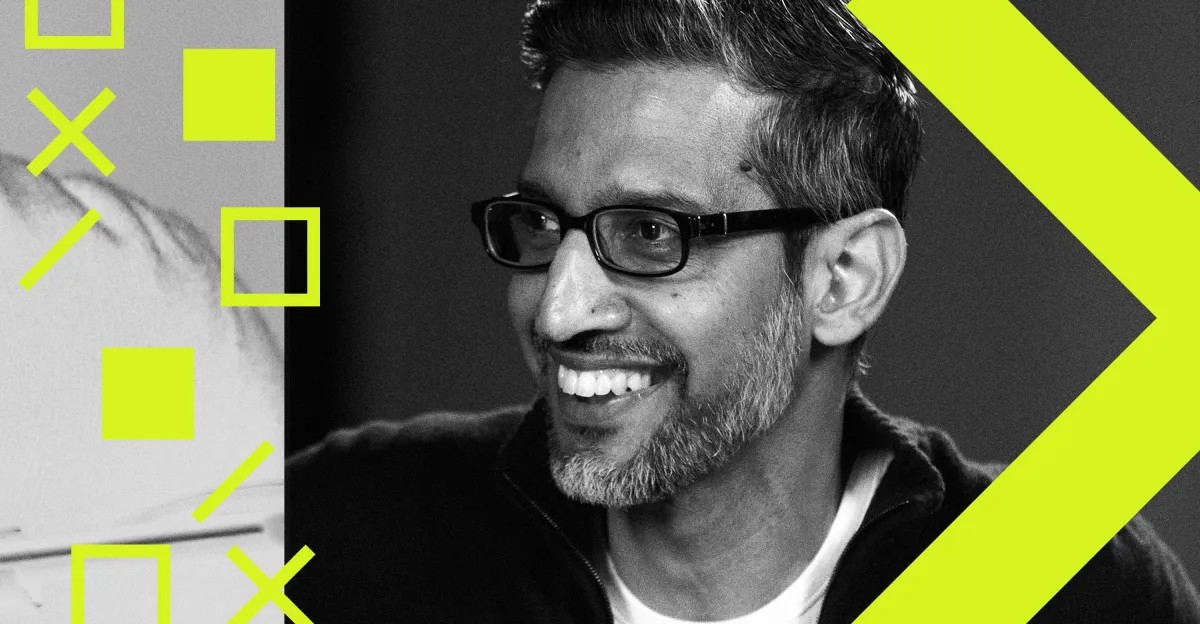
Sundar Pichai looks calm. He sounds tired.
We recorded this after I/O. Again. This is year five. My tradition. We sit down while the dust is still settling from Google’s massive developer conference, and I ask the hard stuff. Not just the flashy demos. The structure. The fear.
Google is changing fast. The Gemini models are here. Agents are everywhere. Search is being dismantled and rebuilt before your eyes. YouTube is next in the crosshairs. And Pichai admits something he used to deflect: he reorganized the entire company because he was scared of OpenAI.
He reorganized it. Not a committee. Not a strategy group. He.
The Structure of Fear
Ask anyone in tech, they’ll tell you Google ships too many things. Overlap. Clutter. Pichai disagrees.
He sees intent. Thirteen billion-user products. That’s not an accident. Gmail. Maps. Chrome. Docs. Search. He’s been deep in these trenches for decades. But now the plumbing is changing.
Before, each product had its own brain. Now? One brain.
Gemini powers them all. Voice, search, docs — same underlying intelligence. This is “Personal Intelligence.” You toggle it on in one app, it knows you in another. It’s seamless because the infrastructure is shared. Pichai calls this the “AI moment.” A new way to organize chaos.
Sometimes you innovate first. Harmonize later.
Remember NotebookLM? It felt like a standalone thing. Now it lives inside Gemini. Notebooks flow back and forth. Innovation at the edge. Integration at the center. That’s the playbook now.
The ChatGPT Wake-Up Call
Go back three years.
The ChatGPT moment hit. Panic. Real panic. Everyone asked, “What is Google doing? Is OpenAI coming to take lunch?”
Pichai says he internalized the shock. He pivoted to AI-first. But the organization couldn’t move. So he broke it.
He merged Google Brain and DeepMind. Hard. Imagine merging Stanford and MIT into one department overnight. He did it. Created Google DeepMind.
He hired Amin Vahdat to centralize AI infrastructure. Brought in Koray Kavukcuoghu as Chief AI Architect.
Then came Search. It was too scattered. Too many cooks. Pichai handed it to Elizabeth Reid. Nick Fox oversaw the wider area. Josh Woodward moved into Labs and Gemini.
Speed. That was the goal.
Pichai started weekly AI product reviews. Every single one. He watched his teams ship. He wanted to see the tech firsthand. No slides. No abstraction.
Deciding Quickly
Most leaders overthink.
Pichai’s framework is simpler. Few decisions actually matter. The rest is just velocity.
You have to decide. Fast.
The few that matter? Like merging DeepMind. Deliberate. Take your time. But for the rest? Pattern matching. Noise vs. Signal. If it looks big but feels routine? Do it. If it feels structural? Stop and think.
This is how you survive an existential threat. You stop arguing. You start building.
Agents and Org Charts
Big Tech is experimenting with crazy structures.
Jack Dorsey wants everyone to report to him. Mark Zuckerberg wants fifty engineers under one manager, armed with AI agents. Pichai? He’s thinking about it. But not quite that wild.
Yet.
Google developers are already using “Antigravity,” an internal AI system. They don’t just write code anymore. They direct agents. Teams of agents. This is happening inside the company now.
It will spill out.
We use Antigravity internally. We provide Antigravity to users.
That’s the bet. The agentic workflows engineers use today will become the product tomorrow. Gemini Spark isn’t just a tool. It’s a superpower. It’s handing the steering wheel to the consumer.
Pichai isn’t focused on cutting costs. He’s focused on native deployment. Making the agent work so well that the distinction between human and machine blurs.
The Zero Traffic Reality
Let’s talk about the open web.
I coined the term “Google Zero” a while back. The idea that Google would answer questions directly on the page. No click needed. Traffic to websites drops to… well. Zero.
Publishers hated it. Then they feared it. Now Condé Nast’s CEO admits it. They’re planning for zero traffic. It’s happening.
Google Search isn’t sending you to a list of blue links anymore. It’s summarizing. It’s answering. It’s triggering tasks.
YouTube is next.
Pichai confirmed they are training models on video content. Searching a video? You don’t get the thumbnail. You get the answer. You land exactly in the minute the cat knocks the glass off the table.
Creators are angry. Publishers are angry.
I asked Pichai if he’s ready for the war with YouTubers.
He didn’t back down. The trend is irreversible. Users want answers, not links. If the answer lives inside Google, the website doesn’t matter. The video doesn’t matter. Only the information matters.
Foothills of the Singularity
Demis Hassabis closed the I/O keynote with a bang. We’re in the “foothills of the singularity.”
Pichai agreed. But he kept the timeline vague.
He believes AGI is coming. He doesn’t say when. Just that the pace of change is accelerating faster than anyone predicted. The Overton window shifted. AI isn’t the future. It’s now.
Five years of this conversation. Sundar has always been willing to look at the phone with me. To read the search results together. To admit what’s broken.
This time, he sounded less like a defender. More like a architect. Building a house on shifting sand.
He thinks it will hold.
The web might not.
Do you want a link? Or do you want the answer?
The question isn’t rhetorical. It’s the end of the line for how we’ve spent the last twenty years. Pichai knows this. The rest of us are just catching up.