
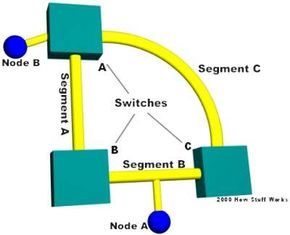
Network loops are a nightmare. You build a redundant topology to ensure availability, but accidentally create a closed circle. Suddenly, a single frame can circulate forever and multiply until it clogs the entire infrastructure. This is a broadcast storm.
This is a failure mechanism. Suppose that node B of switch A needs to communicate with node A of network segment B. The table of switch A does not contain the MAC address of node A. Therefore, frame is flooded from all ports except the receiving port. The frame goes through segment A to switch B and through segment C to switch C.
Switch B and Switch C update their forwarding tables with the location of node B. But they don’t yet know where node A is. Therefore, the frame is flooded from other ports. The frame hits the B segment.
Now the cycle begins. Switch B receives frames from switch C. Switch B has no idea that it just sent the frame (or even that it sent it). You will encounter frameworks that you don’t know how to handle. Then it flooded again. Switch C does the same thing. Switch A receives duplicate data from both sides and fills it.
The result is exponential growth. 1 package became 2 packages. Two becomes four. 4 becomes 8. The network is saturated with repeated traffic in a few seconds. The switch uses all CPU cycles to process frames instead of transferring data. The network effectively dies.
That’s why we need the Spanning Tree Protocol. This is not about increasing bandwidth. It’s all about logic. It’s about closing the loop.
Break the cycle
The solution is not to remove the extra cable. That would break redundancy. The solution is to logically disable certain ports.
Spanning Tree Protocol (STP) runs an algorithm that finds the most efficient path to each network segment. Create a tree structure with a single loop-free path from the root switch to all other switches. All extra links are blocked. They remain alive and ready to take over if the primary path fails, but they do not forward data traffic.
Without STP, the switch assumes that all paths are valid. Through STP we agree which paths are valid. This is a consensus protocol. Prevents broadcast storms by ensuring that there is only one active path between two network nodes.
Why this matters to you
You might think this is only for administrators. It’s not. If your Wi-Fi connection drops or your VoIP calls drop while you’re moving around the house, a loop or blocked port could be to blame. Modern networks are very complex. Redundancy is the norm. However, redundancy that does not prevent loops is a ticking time bomb.
STP has evolved. The original IEEE 802.1D was slow. It takes 30-50 seconds to converge after a failure. This takes forever on live servers. Rapid Spanning Tree (RSTP, 802.1w) reduces the time to seconds. Multiple Spanning Tree (MSTP, 802.1s) improves load balancing between VLANs.
But the principle is the same. Stop the cycle. Maintain redundancy. Continue transferring data.
If you haven’t checked your switch configuration recently, you should do so. A single misconfigured port can turn a clean network into a noisy machine.