It’s a public service to show the technology is reaching a certain threshold of capability. — Alberto Rodriguez, Boston Dynamics Director of Robot Behavior
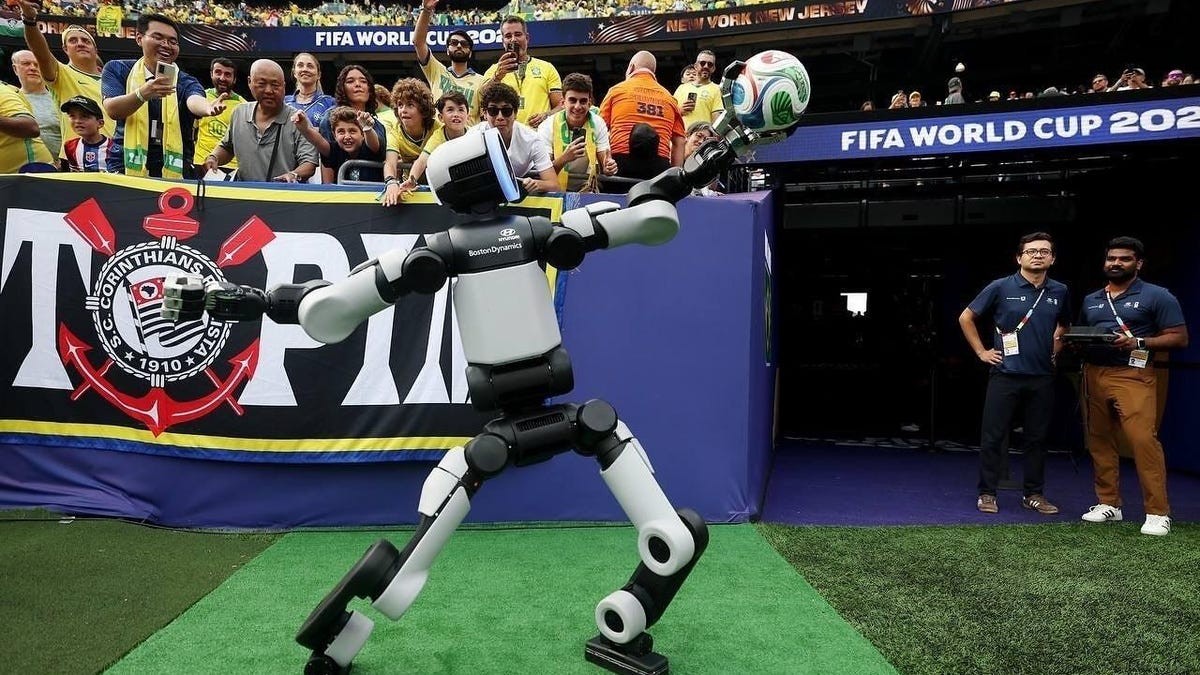
Before the referee touched the ball, the real story was happening off-pitch. Norway vs Brazil. Haltime ends. Out of the tunnel walks Atlas. The humanoid bot doesn’t just walk. It performs. Goal celebrations. The famous dance. Then it passes the ball back.
Shy? Hardly. That performance was just the appetizer.
Back at CES in January I met Atlas. I assumed it could maybe walk around, maybe pick something up. I didn’t bet on World Cup moves by July. I shouldn’t have. This machine isn’t static. It learns. Constantly. The trajectory is clear. Factories first. Service and entertainment second. Our homes last. That’s distant future stuff, sure, but the software upgrades happening now are what get it there.
Boston Dynamics doesn’t keep these tricks secret for sport alone. It’s about showing the curve of progress.
Squeezing the Hardware
Why soccer? Why not juggling or ballet?
Rodriguez says it comes down to raw physics. “High-strength. High-agility.” Soccer forces engineers to squeeze every last ounce of performance from the hardware. You want to know the limit? Push until you break.
The training pipeline is brutal.
– Motion capture records a human move.
– Simulation ingests the data.
– Trial. Error. Failure. Repeat.
Two distinct layers of mastery were required.
First: The limbic system equivalent. Balance. Counter-balance. The split-second muscle memory used by gymnasts and dancers. Atlas needed lightning reflexes just to stay upright.
Second: Manipulation. Force.
Kicking isn’t just about the leg. It’s about friction. It’s about knowing exactly where the foot hits the leather without slipping. This part? It pushed the robot way outside its comfort zone. Modeling a backflip is easier. Gravity is predictable in the air. A rolling ball on turf is chaos.
“Kicking it really well, that’s really hard to do. Learning it through simulation is very, very difficult. You need a real ball.” — Rodriguez
The School of Football videos on YouTube show the messy truth. Tumbles. Catastrophic falls. The body twists into impossible angles. It’s a well-oiled disaster cycle: break it, fix it, learn from it. By the time the world sees the polished clip, the awkward bits are gone. But they were there. Essential there.
The Beckham Problem
Here’s the catch.
Atlas can kick. It’s better than me, at least. I’m creaky and slow. But can it bend a shot like Roberto Carlos or David Beckham?
Nope. Not yet. That subtle curvature requires real-world iteration. Physics engines struggle with that level of nuanced aerodynamics. Simulation falls short. Real grass? Different story.
Rodriguez admits the limitation. You can’t fake that precision. You have to practice.
So will Atlas wear a jersey in 2030?
Unlikely. And here’s why: robots don’t have to take steps to turn. They can invert limbs, rotate joints on a dime. A human-robot mixed league would be a disaster of mixed mechanics. Imagine trying to keep pace with something that defies the rules of human movement. It wouldn’t just be unfair. It would be confusing.
If we see robot soccer, it will be bot versus bot. Pure silicon strategy.
Atlas won’t win the Cup anytime soon. It won’t grace the cover of FIFA 30. But the indirect benefit of forcing it to play ball has elevated its general motor functions. It’s sharper now. Faster.
Maybe it’s time to buy some cleats. Just in case. ⚽️