Your email arrived. Somewhere in the last few seconds, it didn’t travel as one solid block. It was shredded. Broken into tiny chunks. Sent on different routes. Reassembled on the other side. This is the reality of a packet-switched network. It’s the invisible backbone of the modern internet, and it works by breaking data files into smaller units called packets before sending them through a series of nodes or switches.
Think of it like store-and-forward logistics. The switches route these packets independently. They don’t wait for the whole file to arrive. They just push each piece toward its destination. Once everything arrives, the receiving device puts the puzzle back together. The Internet runs on this logic. Most local area networks (LANs) do too.
The Efficiency Trade-Off
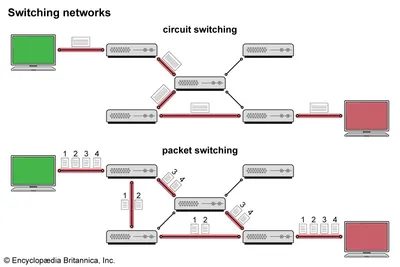
Traditional networks used a different approach. Circuit-switched networks. They built a single physical path for data. A dedicated lane. It held that path open for as long as needed. All info traveled sequentially. If you were on the line, you had the bandwidth. Period.
Packet switching is messier but smarter. It directs packets down multiple paths. Each switch decision improves overall efficiency. If a specific path goes down due to an outage, the packets reroute. They take a different way. This means packets can arrive out of order. The destination system has to sort them out.
There are benefits. Optimized channel capacity. Improved fault tolerance. But it’s complicated. You need significant processing power. You need lots of RAM to handle the chaos. There are also delays from rerouting. Packet loss happens. Because of this complexity, packet switching is preferred for small files. Circuit switching still wins for large, real-time transfers where consistency matters more than efficiency.
Inside the Core and Edge
A packet-switched network has two main zones. The core and the edge. The core consists of routers and control systems. They connect via high-bandwidth channels. The edge is where end-user systems live. Hosts like your personal computer sit here. They send and receive packets.
Communication across the core relies on protocols. These are the rules. The procedures senders and receivers use to talk effectively. The stack of protocols used to transfer your data is called a protocol stack. It’s a layered system. Each layer has a job.
Every transmission, known as a datagram, has two parts. A header. A payload. The header contains control info. Sender address. Receiver address. The payload is the actual information you’re trying to deliver. Sometimes packets split further into smaller units. That’s packet fragmentation. It happens when data exceeds certain size limits.
Connectionless vs. Connection-Oriented
These networks come in two flavors. Connectionless networks. Also called datagram networks. This is the standard model. Data partitions into pieces. Headers attach. The datagrams take the best route from source to destination. No guarantee of order. No guarantee of arrival. Just speed and efficiency.
Then there are connection-oriented networks. Virtual-circuit networks. They mimic circuit switching. They set up a dedicated route before sending anything. This gives you some benefits of the old method while staying on digital networks. It’s a hybrid approach. You pay a setup cost for reliability.
The History of Breaking Things Up
The concept didn’t emerge from nowhere. Paul Baran, an engineer at RAND Corporation, first imagined breaking large data units into smaller packets. He was solving a military problem. How does a computer network survive a nuclear attack? His answer was “hot-potato routing.” Pass the data along quickly. Don’t hold onto it.
He published this between 1960 and 1962. Then released an 11-volume analysis titled On Distributed Communications in August 1964. The government ignored it. Private corporations didn’t care. The idea was too radical. Too abstract.
Meanwhile, Donald Davies worked in the UK. A computer scientist at the National Physical Laboratory (NPL). He arrived at the same concept independently. He started building a network to test it. Baran called his units “message blocks.” Davies called them “packets.” The name stuck.
Lawrence “Larry” Roberts learned of Davies’s work in October 1967. It was a symposium in Gatlinburg, Tennessee. Roberts was managing ARPANET for the U.S. government. He saw the value. He adopted Davies’s term. Packet switching became the standard for ARPANET. The precursor to the Internet we know today.
Why do we still use older methods for some tasks? Because not every problem needs a decentralized solution. Sometimes you just want a straight line. But for the global web? The broken-down, rerouted, reordered mess is exactly what we need. It’s resilient. It’s flexible. It’s the only way to scale.

The Early Days of Packet Switching
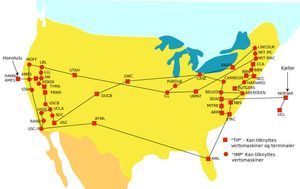
ARPANET didn’t just appear. It was built fast. Bolt Beranek and Newman (BBN) designed it in a single year. They took ideas from Baran and Davies and made them work. The first real test happened in October 1969. It was public. It was packet-switched.
The network started small. Four nodes. UCLA. Stanford Research Institute. UC Santa Barbara. And the University of Utah. By 1975, that number jumped to 57. It was growing.
Showing It Off (and Failing to Impress)
In October 1972, Roberts and BBN showed ARPANET at the first International Conference on Computer Communications. They proved packet switching worked. The reaction? Silence. Or worse. Most of the U.S. communications industry didn’t care. Some even hated the idea.
BBN saw a gap. Roberts and BBN founded Telenet that same year. A commercial network. Built for people who wanted to pay for connectivity instead of researching it for free.
Global Interest Sparks
Other countries moved faster. In November 1973, the French postal division announced TRANSPAC. A domestic packet network. By October 1974, the Trans-Canada Telephone System launched DATAPAC. Japan’s NTT was also planning its own public data network.
Most providers stayed skeptical. They watched. They waited. They wanted to see if the early networks would actually survive.
New Experiments in Europe
While public networks were being built, researchers were playing. Davies finished the Mark II network in 1973. It started at the NPL in 1970. It influenced the UK and much of Europe.
Louis Pouzin, a French computer scientist, finished CYCLADES that same year. It used datagrams. It changed how people thought about error correction. Instead of the network core fixing mistakes, the hosts did it. This shift mattered. It made the network smarter. The European Informatics Network (EIN) came online in 1976. Internationally funded.
Standardizing the Chaos
Five nations had to agree on something. Canada. France. Japan. The U.K. The U.S. They needed a standard host-network interface. Talks started in 1975.
The result was CCITT Recommendation X.25. Adopted in March 1976. It ushered in the next phase of packet switching. Interconnected public service networks. X.75 soon followed. A standard for connecting international networks.
The Birth of TCP/IP
Robert Kahn became director of DARPA’s IPTO in 1979. The U.S. Department of Defense had multiple packet-switched networks. None of them talked to each other.
Kahn fixed that. He had the Defense Department adopt TCP/IP. A protocol standard he imagined with Vincent Cerf. Cerf was a prominent software developer. Kahn had written a paper on it in 1974.
TCP/IP spread. It went to research labs. Then to the public. It became the basis for the ultimate packet-switched network. The Internet.
Does it feel like history repeating itself? We built the pipes. Then we filled them. The technology was ready. The infrastructure was there. We just kept adding nodes.