Modern encryption is complex, but its roots are surprisingly simple. At its core, a product cipher is just a way to layer security. You take a plain document, encrypt it once, and then encrypt that result again. By stacking two or more basic substitution or transposition methods, you create a wall that is significantly harder to break than a single layer.
In the era before computers, cryptographers relied on this technique heavily. They didn’t have algorithms to do the heavy lifting. Instead, they used word-based keys and rectangular matrices to shuffle data. One popular variation was the fractionation system. Here’s how it worked: first, you swap symbols in the plaintext for multiple new symbols. If you are turning single letters into pairs, it is called a biliteral cipher. Then, you apply a final transposition step. This last stage is often called superencryption.
The most famous example of this was the ADFGVX cipher. The German army deployed it during World War I. It was a field cipher that combined substitution and transposition in a way that was both clever and deadly.
The ADFGVX Mechanism
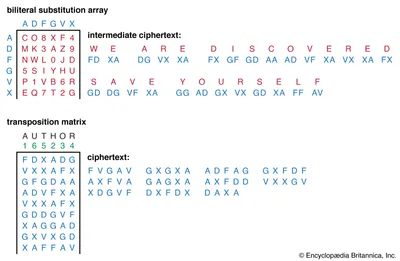
The ADFGVX system used a 6×6 matrix. This grid handled the 26 letters of the alphabet and the 10 digits. Every character in the original message was substituted into a pair of symbols chosen from this set: A, D, F, G, V, and X. This created the biliteral cipher.
But the encryption didn’t stop there. The resulting pairs were written into a rectangular array. The final step was a route cipher. Soldiers would read the columns in a specific order determined by a keyword. This transposition scrambled the already substituted text. It made the message nearly unintelligible to anyone who didn’t know the matrix and the keyword.
The ADFGVX cipher was one of the most famous field ciphers of all time.
Why It Mattered
This wasn’t just academic exercise. It was battlefield intelligence. The Germans trusted this system. They believed the combination of substitution and transposition was secure. For a time, it was. But the layering also created a predictable structure. That structure became the key to its downfall.
In 1918, the French cryptanalyst Georges J. Painvin broke the code. He didn’t have a supercomputer. He used statistical analysis and pattern recognition. Painvin identified critical vulnerabilities in how the German army used the cipher. His success had immediate and devastating effects. It tipped the balance at the Second Battle of the Marne.
The German army’s confidence in their product cipher collapsed. The layering that was supposed to protect their communications instead made them vulnerable to a skilled human analyst. Painvin’s work showed that even complex manual systems have limits. It proved that no matter how many layers you add, if the underlying method has a flaw, it will be exposed.
We still use the same basic logic today. Software encryption still layers algorithms. But now, the “product” is handled by silicon, not paper grids. The principle remains the same though. More layers can mean more security. But they can also mean more complexity. And complexity is where mistakes happen.
The ADFGVX cipher is a relic now. But its story is still relevant. It reminds us that security is not just about the tools