
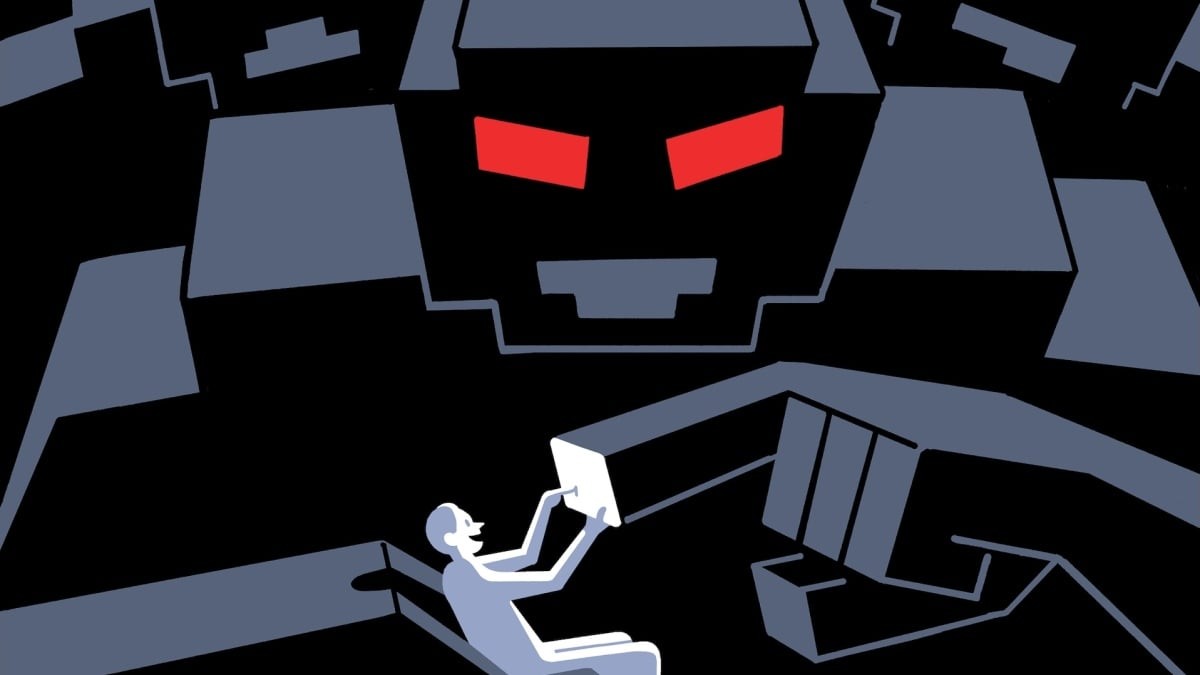
The latest cover of The New Yorker, titled “New Horizon,” has sent shockwaves through the creative community. Created by renowned illustrator Christoph Niemann, the artwork departs from the magazine’s traditional whimsy, opting instead for a visual style reminiscent of a horror film poster.
The image depicts a blood-red sky dominated by towering, menacing AI entities. Below them, a solitary human figure appears oblivious to the looming threat, unaware that the very atmosphere is closing in.
The Illusion of Benign Technology
In a recent interview, Niemann shared the philosophy behind the piece, highlighting a growing disconnect between how AI is marketed and how it actually functions.
While AI interfaces are typically designed to be user-friendly, “clean,” and “obedient,” Niemann suggests this polished aesthetic is deceptive.
“Even when using AI professionally, it always feels benign to me,” Niemann noted. “The simple, clean design of the chatbot sites… It’s designed to feel harmless and fun.”
This contrast is the core of the cover’s tension: the user experience is tranquil, yet the underlying technological shift is predatory. The “New Horizon” refers to both a literal landscape and a metaphorical era that humanity is entering—one where the scale of change may be too vast for the average person to perceive until it is too late.
A Crisis of Creativity and Ethics
Niemann’s concerns extend beyond mere science fiction tropes; they are rooted in the economic and ethical realities facing modern creators. He draws a sharp distinction between historical technological shifts and the current AI revolution.
While the invention of photography fundamentally altered the landscape for painters, Niemann argues that the current AI model is fundamentally different:
- Disruption vs. Plagiarism: Unlike photography, which captured reality through a lens, generative AI is built upon the massive ingestion of existing human-made art.
- Economic Displacement: The sheer scale of AI’s ability to replicate styles poses a direct threat to the livelihoods of artists, writers, and designers.
- The Value of Human Connection: Niemann posits that while a machine might achieve technical perfection, it lacks the “soul” that drives human engagement.
Is There Room for Optimism?
Despite the dark imagery, Niemann holds onto a singular hope: the enduring human desire for authentic connection. He uses the analogy of a musical performance to illustrate this point, noting that even if a robot could play a piano with superhuman speed and precision, it would lack the emotional resonance that draws audiences to live human performances.
The central question raised by “New Horizon” is whether society will continue to value the process and imperfection of human creation, or if we will succumb to the convenience of automated, derivative content.
Conclusion
Christoph Niemann’s cover serves as a visual warning that the “friendly” interface of artificial intelligence may mask a much more disruptive and predatory reality for human culture. The piece challenges us to decide whether we will prioritize technological efficiency or the irreplaceable value of human expression.