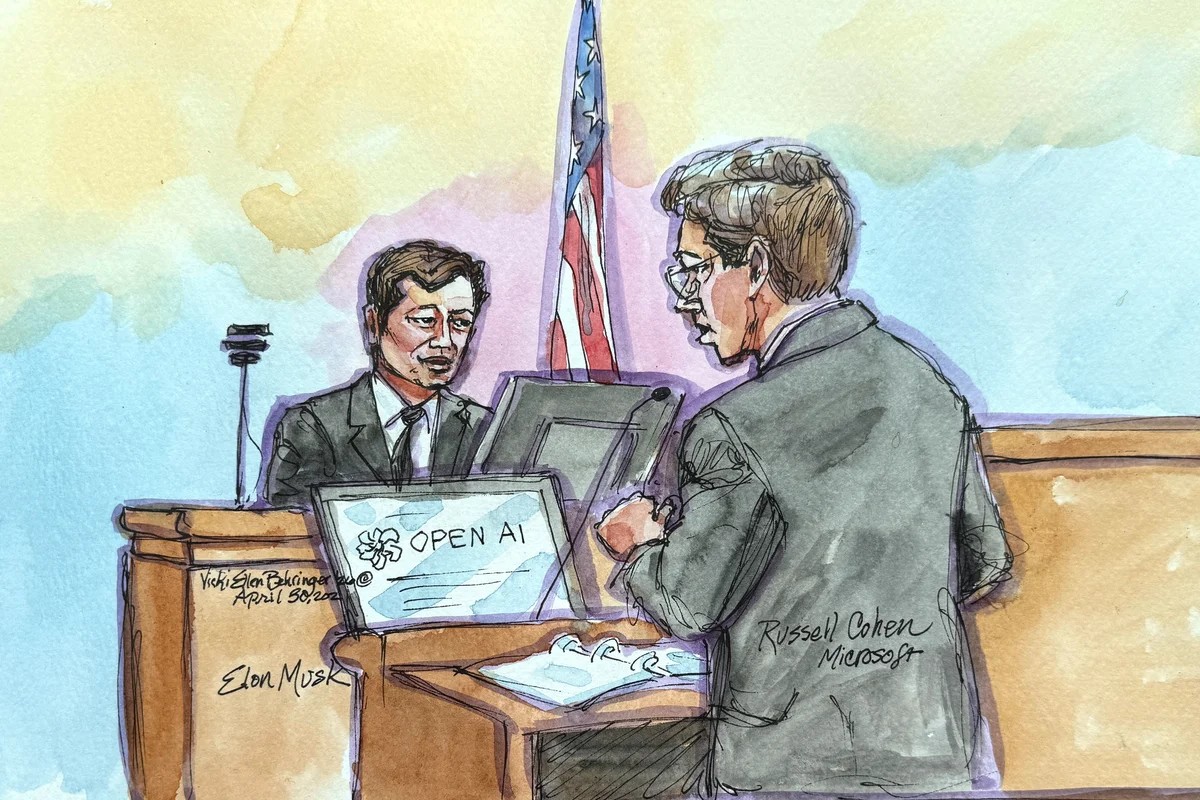
Elon Musk’s testimony at the center of a high-stakes legal battle with OpenAI revealed a critical discrepancy between verbal assurances and written agreements. On Thursday, the Tesla and SpaceX CEO took the stand to assert that he relied on personal guarantees from co-founder Sam Altman that the artificial intelligence company would remain a nonprofit organization, despite early internal discussions about shifting to a for-profit model.
The trial, currently in its third day in a California federal court, represents a pivotal moment for the tech industry. It is not merely a dispute over corporate governance; it is a clash over the fundamental philosophy of AI development and the validity of trust in billion-dollar partnerships.
The Core Dispute: Verbal Trust vs. Written Contracts
The central tension of Musk’s testimony revolved around a term sheet dated August 31, 2017. This document outlined OpenAI’s transition from a purely nonprofit research lab to a hybrid structure featuring a for-profit entity (OpenAI LP) overseen by a nonprofit (OpenAI Inc.).
When pressed by William Savitt, legal counsel for OpenAI, Altman, and President Greg Brockman, Musk admitted he did not scrutinize the detailed legal language of the agreement.
“My testimony is I didn’t read the fine print, just the headline,” Musk stated.
Musk argued that he was personally reassured by Altman and other founders that the organization’s core mission—developing safe AI for the benefit of humanity—would remain unchanged and that the entity would operate as a charity. He contends that OpenAI breached this charitable trust by pivoting to a for-profit structure to enrich its founders and executives, effectively stealing the value generated by his $38 million in donations and his influence in securing early partnerships.
Why This Matters: The Stakes Are Trillion-Dollar High
This lawsuit is more than a personal grievance; it has profound implications for the future of OpenAI, the creator of the ChatGPT chatbot. The company has raised billions in investment and is reportedly preparing for an initial public offering (IPO) that could value the firm at $1 trillion.
Musk is seeking $150 billion in damages, which he intends to direct to OpenAI’s charitable arm. Additionally, he is demanding:
* A return to nonprofit status.
* The removal of Sam Altman and Greg Brockman from their executive positions.
* Altman’s removal from the board of directors.
The outcome could set a precedent for how early-stage tech ventures handle the transition from mission-driven startups to commercial giants, particularly when significant external funding and personal reputations are on the line.
OpenAI’s Defense: Necessity and Resentment
OpenAI and its leadership have vigorously contested Musk’s claims. They argue that the shift to a for-profit structure was a strategic necessity to attract the massive capital required for computing power and to recruit top-tier scientific talent. Without this pivot, they contend, the company could not have scaled its research or maintained its competitive edge.
Furthermore, OpenAI’s defense suggests Musk’s motives are driven by:
1. Resentment: Anger over OpenAI’s success following his departure from the board in 2018.
2. Control: A desire to exert influence over a company that no longer answers to him.
3. Competition: An effort to bolster his own AI venture, xAI, which currently lags behind OpenAI in user adoption and technological capability.
During the trial, Musk confirmed that xAI has used OpenAI’s models to train its own systems, describing it as “standard practice” in the industry. This admission highlights the complex, interconnected nature of the AI ecosystem, even among fierce competitors.
Courtroom Dynamics and Judicial Oversight
The proceedings were marked by friction between Musk and OpenAI’s legal team. Musk expressed frustration with Savitt’s questioning style, accusing the lawyer of interrupting his answers.
“Few answers are going to be complete, especially when you cut me off all the time,” Musk remarked.
U.S. District Judge Yvonne Gonzalez Rogers intervened, admonishing Savitt for interrupting but dismissing Musk’s complaints about leading questions. The judge also rejected Musk’s attempt to introduce expert testimony regarding the existential risks of AI, noting the irony of Musk warning about extinction risks while running his own competing AI company.
“This is not a trial on the safety risks of artificial intelligence,” Judge Rogers stated, emphasizing that the court’s focus must remain on the contractual and fiduciary disputes.
Conclusion
As the trial continues, the focus remains on whether OpenAI’s evolution into a for-profit powerhouse constitutes a betrayal of its original charitable mission or a necessary adaptation for survival and growth. Musk’s admission that he ignored the “fine print” underscores the dangers of relying on verbal assurances in complex corporate structures, leaving the court to decide if trust or text holds more weight in the age of artificial intelligence.