The gap between “cheap OLED” and “good gaming OLED” usually spans hundreds of dollars. Until now.
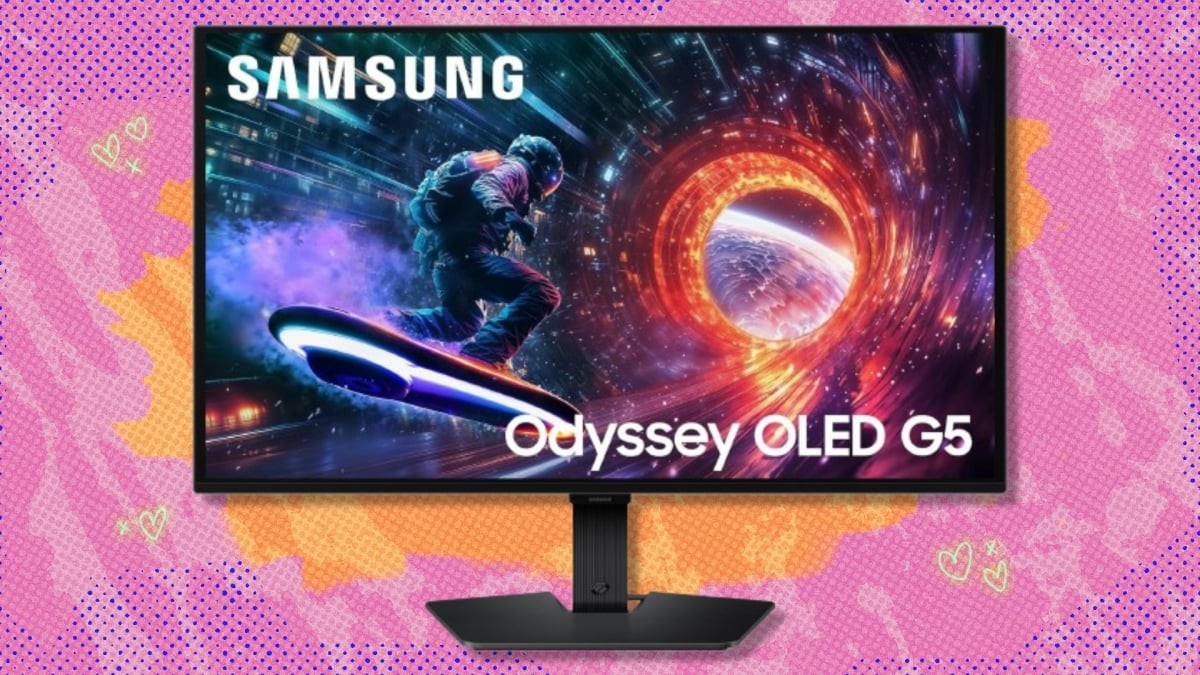
Samsung’s 27-inch Odyssey QD-OLED G3/G5 (the specific model referenced is often grouped under the G-series marketing, technically the S90D or G-series OLED panels, but marketed here as Odyssey OLED G5/G6 equivalents in the source text’s context of QD-OLED at this price point) is dropping below $350 for the first time in a significant way.
Specifically, Amazon has cut the price to $349.5. That’s not a typo.
For those who’ve been watching the OLED market bleed prices downward but waited for a panel that isn’t a sub-par TV panel repurposed as a monitor, this is the moment. The previous benchmark sat around $499. Dropping nearly 30% changes the entire value proposition of buying a dedicated gaming display in 2024 (and looking ahead to 2026 as per the article’s dated metadata, though the tech reality is immediate).
What is the Samsung Odyssey OLED G5 exactly?
Let’s strip away the marketing fluff. This isn’t your grandfather’s LCD. It uses Quantum Dot Organic Light-Emitting Diode technology.
QD-OLED means you get the perfect blacks inherent to OLED pixels turning off entirely. But it adds a quantum dot layer for better brightness and color volume.
The key specs at the sale price ($349.54):
– Resolution: 2560 x 1440 (QHD)
– Refresh Rate: 180Hz
– Response Time: 0.03 milliseconds (Gray-to-Gray)
– Size: 27 inches
– Price: $349.59 at Amazon
At nearly $350, you aren’t just buying a screen. You’re buying a ticket out of the blurry, washed-out mess of standard IPS panels when things get chaotic in a match.
Is an $350 QD-OLED monitor actually any good?
Short answer? It obliterates competitors at this price bracket.
Why does this matter? Because QHD is the sweet spot. 1080p looks pixelated on a 27-inch screen unless you sit farther away. 4K is nice, but it kills performance on mid-range GPUs and requires higher resolutions for text clarity that this specific panel doesn’t optimize for at the cost of sharpness. 1440p sits in the Goldilocks zone for PC gamers who want detail without demanding an RTX 4090.
The 180Hz refresh rate is the killer feature here. For competitive titles—think Overwatch 2, Fortnite, Valorant, or Marvel Rivals —every frame counts. 180Hz ensures that when your mouse jitters, the screen updates with it. No lag. No tearing.
And if you use AMD cards or NVIDIA GPUs? You get FreeSync and G-Sync Compatible. That eliminates screen tearing. The two technologies sync your monitor’s refresh rate to your graphics card’s output. Result? Smooth, stutter-free action even when your frame rates dip.
Visual fidelity beyond the games
This monitor is also validated by Pantone.
That’s a big deal for creatives and media bingers who want accurate skin tones and colors. The monitor covers over 110 skin tones specifically, and over 2,100 colors total.
So, whether you’re color-grading a quick edit or watching Assassin’s Creed on Netflix, the images pop. The HDR10 support means brighter highlights and deeper shadows without blowing out the image. The “black” in an OLED is actual black. Not gray-black like an LCD with its backlight bleed. Pure void.
It makes movies sharper. Games more immersive. Text cleaner.
Who is this for?
- Competitive gamers: 0.03ms response time means inputs register faster than on 4ms LCDs.
- Multimedia junkies: Perfect blacks enhance HDR content.
- Budget-conscious upgraders: This price point has rarely seen QD-OLED technology outside of TV panels (which often lack 144Hz+ refresh rates on standard HDMI 2.0 connections).
Should you buy it now?
Yes.
Prices fluctuate. Deals evaporate. This is one of the best entry points into true high-end gaming display technology for under $400. The savings are roughly $150 off the standard retail. That’s a significant chunk of cash you’re keeping in your pocket for peripherals or games.
Stock is limited. If the $349 price is active, don’t sleep on it. The shift in monitor pricing is accelerating. Wait until prices go up, or wait for the next generation which will be even pricier at launch. This current gen QD-OLED is proven. It works. It looks insane. And it’s affordable right now.
The screen won’t fix your aim. But it might let you see exactly where the enemy was standing before you did. That’s worth the price of admission.