
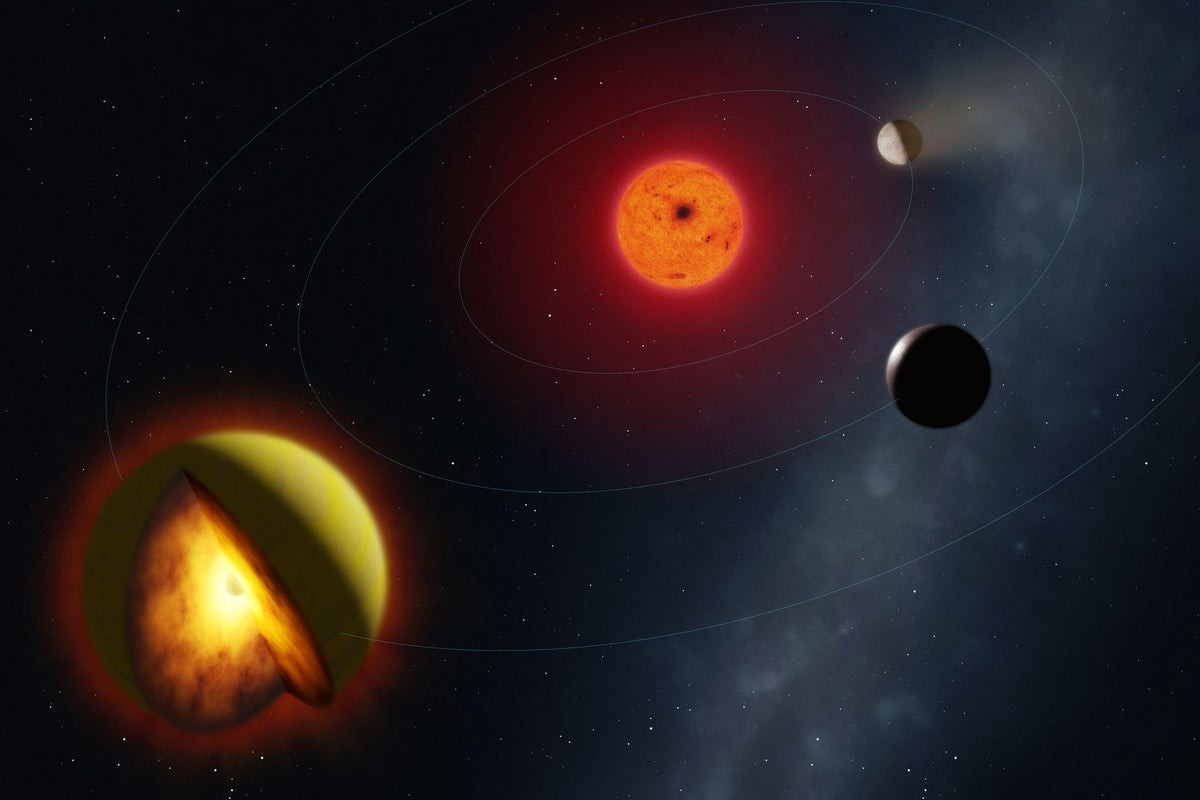
Astronomers have identified a previously unknown type of planet: a “molten world” with a deep, planet-wide ocean of magma and an atmosphere rich in sulfur compounds. This discovery challenges existing planetary classifications and suggests the universe may hold far more diverse worlds than previously imagined.
A Sulfur-Rich Interior
The planet, designated L 98-59 d, orbits a star located approximately 35 light-years from Earth. Unlike the two main categories scientists previously used—gas dwarfs or water worlds—this exoplanet features a unique internal structure. Simulations suggest its mantle is composed of molten silicate, similar to terrestrial lava, overlying a vast magma ocean extending throughout the planet. This ocean acts as a reservoir for sulfur and enables the planet to retain its hydrogen-rich atmosphere.
How the Discovery Was Made
The identification of L 98-59 d’s unusual composition was made possible by combining observations from the James Webb Space Telescope with data from Earth-based telescopes. Researchers then used computer models to reconstruct the planet’s life cycle, starting from its formation roughly five million years ago. This allowed them to match observations to internal processes.
Preventing Atmospheric Loss
Without the magma ocean, the planet’s atmosphere would likely escape into space due to the intense X-ray radiation from its star. The molten reservoir stabilizes the atmosphere by trapping volatile gases, including hydrogen sulfide. The planet is roughly 1.6 times the size of Earth but not dense, meaning it’s composed of lighter materials.
Implications for Exoplanet Diversity
The team believes many similar planets may exist throughout the galaxy. The study implies that our current planetary categorization system is inadequate and that there could be entirely new classes of worlds waiting to be discovered. “This discovery suggests that the categories astronomers currently use to describe small planets may be too simple,” said lead author Harrison Nicholls from the University of Oxford.
“While this molten planet is unlikely to support life, it reflects the wide diversity of the worlds which exist beyond the Solar System.”
The research, published in Nature Astronomy, raises a fundamental question: what other planet types remain hidden in the cosmos? The findings underscore the potential for uncovering even stranger and more complex exoplanets in the future.