The intersection of technology, politics, and media is blurring in ways that are both surreal and revealing. From AI-generated religious imagery used by political leaders to the shifting financial alliances of Washington’s media elite, the digital landscape is reshaping how influence is wielded and how institutions survive.
The Digital Iconography of Donald Trump
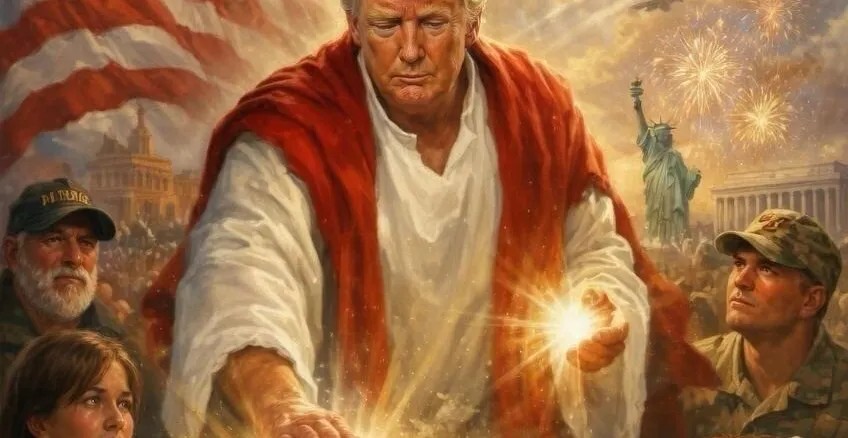
In a move that has sparked significant debate among religious conservatives, Donald Trump has begun sharing AI-generated imagery depicting himself in divine contexts. Most recently, Trump shared an image on Truth Social showing himself styled as Jesus Christ, surrounded by angels and performing miracles.
While the imagery may seem like mere internet whimsy, it carries deeper implications for his relationship with the religious right.
– The Content: The image was not entirely original; it appears to be a modified version of an AI artwork previously shared by a MAGA influencer.
– The Alterations: Observers noted strange transformations between the original and Trump’s version. Elements that once appeared benevolent—such as a soldier in the clouds—shifted into what many users described as demonic, spiky-headed entities. Faces also appeared more fearful rather than peaceful.
– The Reaction: The use of such imagery has drawn sharp criticism. Conservative commentator Rod Dreher noted that while he isn’t explicitly calling Trump the “Antichrist,” the imagery “radiates the spirit” of such a figure, highlighting a potential fracture in the alliance between the former president and traditional religious voters.
This trend signals a shift in political communication: the use of generative AI to create highly personalized, emotionally charged, and often controversial “digital icons” to bypass traditional media and speak directly to a base through mythic symbolism.
The Economics of Washington Socializing
In Washington, D.C., the scale of a media company’s social events serves as a barometer for its financial health. A recent look at the White House Correspondents’ Dinner season reveals a landscape of strategic—and sometimes desperate—collaborations.
As traditional media faces shrinking margins, the “who is paying” question has become central to the city’s social fabric:
– Tech-Funded Receptions: Large tech entities are increasingly stepping in to subsidize events for struggling news outlets. For example, YouTube is co-hosting a reception with CSPAN, the latter of which is facing financial headwinds due to the decline of cable television.
– Corporate Sponsorships: Publications like Washingtonian are partnering with wealthy foreign entities, such as the Embassy of Qatar, to maintain their high-end event standards.
– The Decline of Giants: Even major players are feeling the squeeze. The Washington Post, despite its billionaire ownership, has reportedly downgraded its event scale following significant financial losses and newsroom layoffs.
– Nonprofits as Access Vehicles: Organizations like America250 have evolved from nonpartisan entities into conduits for corporate donors—including Amazon, Meta, and Oracle—to curry favor with the administration.
These partnerships highlight a growing trend: the “corporatization” of political access, where tech giants and major donors effectively bankroll the social infrastructure of the press.
Werner Herzog on the “Deranged” Penguin
The phenomenon of digital recontextualization reaches a peak in the way political entities use archival footage to create memes. Recently, the Trump administration and the Department of Homeland Security utilized a clip from Werner Herzog’s 2010 documentary, Encounters at the End of the World.
In the film, Herzog captures a penguin wandering away from its colony toward the mountains. While MAGA-aligned social media accounts used the clip to symbolize “nonconformist free thinkers,” Herzog offers a much darker interpretation.
“The penguin is simply… not I would not say insane. I have a better word for it: deranged.” — Werner Herzog
Herzog expressed bewilderment at why a sequence from 18 years ago would suddenly explode as a political meme. While he conceded the principle of free speech, he noted the “heartbreaking” reality that the clip is often stripped of its original context—a story of a creature heading toward certain death—to serve as a celebratory symbol of independence.
Conclusion
Whether through AI-generated divinity, tech-subsidized journalism, or the repurposing of cinematic tragedy, the boundary between reality and digital interpretation continues to dissolve, leaving audiences to navigate a landscape where context is increasingly secondary to impact.