The rapid deployment of AI agents has created a dangerous “governance emergency.” While 79% of organizations have already integrated AI agents into their workflows, a staggering disconnect exists between adoption and security: only 14.4% of companies have full security approval for their agent fleets, and just 26% have established formal AI governance policies.
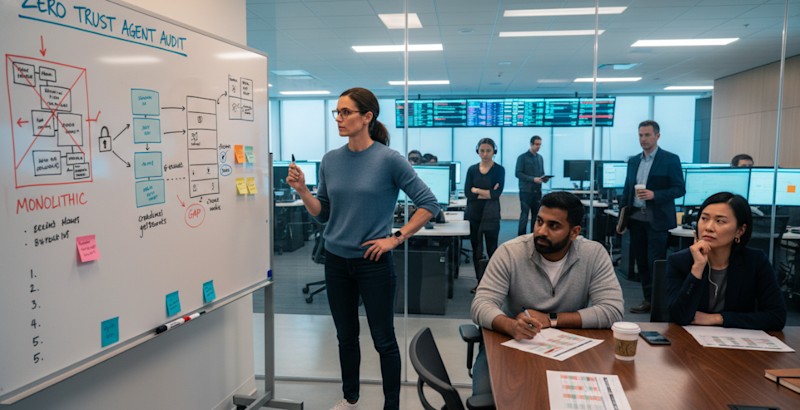
At the center of this crisis is a structural flaw in how most agents are built. The industry is currently moving away from a “monolithic” model—where reasoning, execution, and sensitive credentials all live in one vulnerable container—toward two competing zero-trust architectures.
The Monolithic Problem: A “Blast Radius” Nightmare
Most enterprise AI agents currently follow a monolithic pattern. In this setup, a single process handles everything: it reasons (the model), calls tools, executes code, and holds high-level credentials (like OAuth tokens and API keys).
This creates a massive security risk:
– Single Point of Failure: A single prompt injection attack can grant an adversary access to the entire container.
– Credential Exposure: Because tokens sit in the same environment where the agent runs unverified code, an attacker can easily exfiltrate them.
– Lack of Accountability: Data shows that 68% of organizations cannot distinguish between agent activity and human activity in their logs, making forensic investigation nearly impossible.
The stakes are high. Recent reports, such as the ClawHavoc supply chain campaign, demonstrate how quickly attackers can exploit agentic frameworks. With breakout times dropping as low as 27 seconds, the window for manual intervention is virtually non-existent.
Two Paths to Zero Trust: Anthropic vs. Nvidia
As the industry realizes that “trusting” an agent is not an option, two major players have released competing architectures to solve the problem. They approach the “blast radius” from opposite directions.
1. Anthropic: The “Separation of Powers” Model
Anthropic’s Managed Agents architecture uses a structural split to ensure that the “brain” never touches the “keys.” It divides the agent into three distinct, non-trusting components:
* The Brain: The reasoning engine (Claude) and the routing harness.
* The Hands: Disposable Linux containers where code is actually executed.
* The Session: An external, append-only event log that tracks everything.
The Security Advantage: Credentials never enter the execution sandbox. When an agent needs to use a tool, it sends a request to a proxy that fetches a token from a secure vault. The agent itself never sees the actual credential. If an attacker compromises the “hands,” they find themselves in an empty room with nothing to steal.
2. Nvidia: The “Fortified Sandbox” Model
Nvidia’s NemoClaw takes a different approach. Rather than separating the components, it wraps the entire monolithic agent in five layers of intense monitoring and restriction.
* Kernel-Level Isolation: Uses tools like Landlock and seccomp to sandbox execution.
* Intent Verification: A policy engine intercepts every action the agent proposes before it hits the host.
* Privacy Routing: Sensitive queries are directed to local models to prevent data leakage.
The Trade-off: While NemoClaw provides high visibility, it requires more human oversight. The “observability” comes at the cost of autonomy; every action that falls outside of a strict policy requires manual approval, which can become expensive and slow as you scale.
The Critical Distinction: Credential Proximity
The most vital question for security directors is: How close are the credentials to the execution environment?
| Feature | Anthropic (Managed Agents) | Nvidia (NemoClaw) |
|---|---|---|
| Strategy | Structural Removal: Credentials are kept in an external vault. | Policy Gating: Credentials are injected into the sandbox but restricted by policy. |
| Risk Profile | An attacker must perform a complex “two-hop” attack to reach credentials. | An attacker in the sandbox has direct access to environment variables (tokens). |
| Resilience | High: If a container crashes, the session persists externally. | Lower: If the sandbox fails, the agent’s state is lost. |
This distinction is critical when facing indirect prompt injection (where an agent is manipulated by reading a poisoned website or API). In Anthropic’s model, an injected instruction can trick the “brain” but cannot reach the “vault.” In Nvidia’s model, the injected context sits right next to the execution environment, representing a wider surface area for exploitation.
🛡️ Security Checklist for AI Deployment
To navigate this transition, organizations should prioritize the following:
- Audit for Monoliths: Immediately identify any agents holding OAuth tokens or API keys within their execution environments.
- Demand Isolation in RFPs: When buying AI tools, ask whether they structurally remove credentials (like Anthropic) or merely gate them through policy (like Nvidia).
- Test Durability: Before production, simulate a sandbox crash. If the agent cannot resume its task from an external log, your long-running workflows are at risk of data loss.
- Plan for Staffing: If choosing a highly observable model like NemoClaw, ensure you have the budget for the human operators required to approve agent actions.
Conclusion: The era of “unsupervised” AI agents is ending. As the gap between deployment speed and security readiness closes, the winners will be those who treat AI agents not as trusted users, but as highly intelligent, high-risk entities that require continuous, structural verification.