
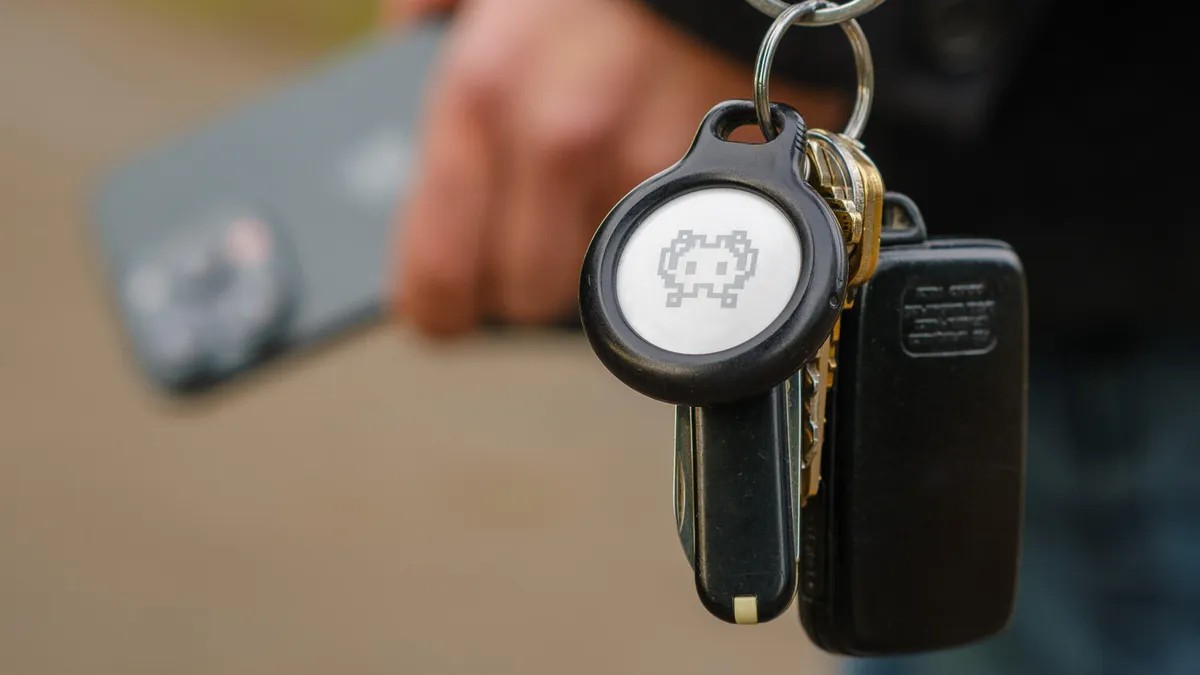
Losing a set of keys or a piece of luggage can trigger immediate anxiety. Whether it is a bag lost in the labyrinth of an international airport or a wallet left at a cafe, the feeling of helplessness is universal. Apple AirTags aim to solve this problem by turning your lost items into visible points on a map.
With the release of the second-generation AirTag, Apple has refined the hardware to make tracking even more precise and audible. This guide breaks down how the technology works, what has changed, and how to use it effectively.
🔍 What is an AirTag?
An AirTag is a compact, Bluetooth-enabled tracking device designed to help you locate personal belongings. Roughly the size of a large coin, these “pucks” are built to be unobtrusive. They use a standard CR2032 coin cell battery, which typically lasts about a year before needing replacement.
Once paired with an iPhone or iPad, the AirTag becomes part of the Find My network, allowing you to track its location via the Apple ecosystem.
🚀 What’s New in the Second Generation?
While the physical design remains largely unchanged, the internal upgrades in the second-generation model offer significant functional improvements:
- Enhanced Precision Finding: A new second-generation Ultra-Wideband (UWB) chip increases the detection range by 1.5x.
- Apple Watch Integration: You can now use an Apple Watch Series 9 (or later) and Apple Watch Ultra 2 (or later) to guide you directly to your item.
- Extended Bluetooth Range: A new chip allows the AirTag to communicate more effectively with nearby devices, improving its ability to report its location to the network.
- Improved Audio: The internal speaker is 50% louder and produces a new, distinct chime designed to cut through noisy environments.
How to distinguish between generations
Because they look nearly identical, look at the back. The second-generation model features all-caps lettering and explicitly lists “Find My,” “NFC,” and “IP67” (indicating water and dust resistance).
🌐 The “Secret” Behind the Tech: How It Works
A common misconception is that AirTags have long-range GPS. In reality, the AirTag itself has a very limited range. Its “superpower” is actually the Apple Find My network.
- The Signal: The AirTag emits a low-power Bluetooth signal.
- The Relay: When any nearby iPhone, iPad, or Mac passes by, it picks up that signal.
- The Update: That stranger’s device securely and anonymously sends the AirTag’s location to Apple’s servers.
- The Result: You see the location on your map.
Note: This process is private. No personal information about the stranger’s device is shared, and the impact on their battery is negligible.
🛠️ Practical Usage and Management
Setting Up and Locating
Setup is seamless: pull the battery tab, bring it near your iPhone, and tap “Connect.” To find an item, use the Find My app.
* Nearby: Use “Play Sound” or the “Precision Finding” feature (on iPhone 11 or later) which provides directional arrows to lead you to the exact spot.
* Far Away: The app provides directions via Maps to help you navigate to the last known location.
Managing Lost or Stolen Items
- Left Behind Alerts: Enable “Notify When Left Behind” to receive a notification if you walk away from an item.
- Lost Mode: If an item is truly gone, you can enable “Lost Mode” to display your contact information to whoever finds it.
- Sharing Location: If your item is stolen, you can share its location via a secure link with the police.
Privacy and Safety
Apple has implemented safeguards to prevent stalking. If an unknown AirTag is moving with you, your iPhone will alert you. You can then use the “Identify Found Item” feature to see the tag’s serial number or disable it.
💰 Buying Guide and Compatibility
| Feature | Detail |
|---|---|
| Single Unit Price | ~$29 (Apple) / ~$24 (Retailers) |
| Best Value | 4-packs (often ~$75 at major retailers) |
| Battery Type | CR2032 (Replaceable) |
| Android Support | No native app. You can only use NFC to view info on found tags. |
💡 Pro Tip: If you are looking for a budget option, older first-generation AirTags are often heavily discounted and remain highly effective for basic tracking.
🏁 Conclusion
Apple AirTags leverage a massive global network of devices to turn lost items into findable ones. While the second generation offers better range and sound, the core value remains the same: providing peace of mind through seamless, automated location tracking.