
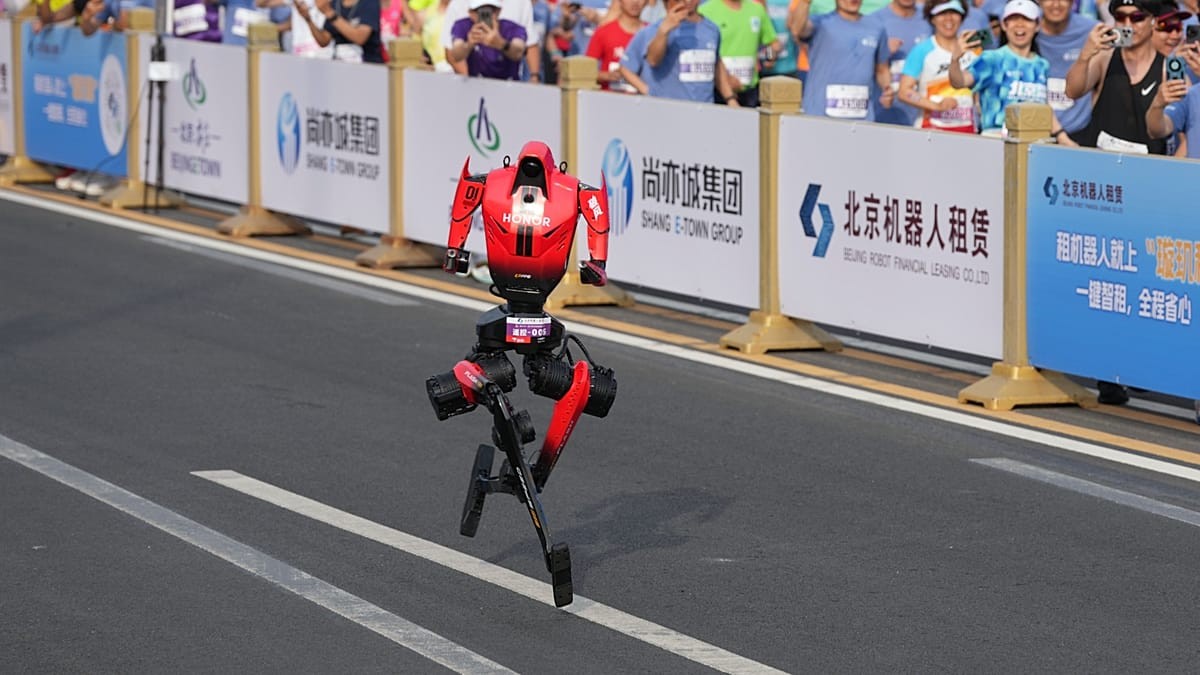
In a significant milestone for the field of robotics, a humanoid robot has outperformed the human world record in a half-marathon. During the Beijing E-Town Humanoid Robot Half-Marathon this past Sunday, a machine developed by the Chinese tech firm Honor completed the 21-kilometer course in just 50 minutes and 26 seconds.
To put this achievement in perspective, the current human world record for the distance is approximately 57 minutes, set by Uganda’s Jacob Kiplimo earlier this year.
Engineering Inspired by Elite Athletes
The success of the Honor robot is not accidental; it is the result of biomimetic engineering. According to Honor engineer Du Xiaodi, the robot was specifically modeled after elite human runners to optimize its gait and efficiency.
Key technical features contributing to its performance include:
– Biomimetic Proportions: The robot features elongated legs measuring roughly 0.95 meters to mimic the stride of professional runners.
– Advanced Thermal Management: To combat the intense heat generated by high-speed movement, the robot utilizes a sophisticated, in-house developed liquid-cooling system.
A Test of Autonomy and Endurance
The event served as a massive real-world stress test for machine intelligence. While 12,000 humans participated, they ran on parallel tracks to ensure safety. The robotic field was equally ambitious, featuring over 100 machines.
A critical distinction in the race was the level of control:
– Autonomous Navigation: Approximately 40% of the robots navigated the course entirely on their own.
– Remote Control: The remaining machines were operated by human pilots.
While a remote-controlled Honor robot crossed the line first with a time of 48 minutes and 19 seconds, the autonomous model was declared the overall winner under the competition’s specific scoring criteria. Honor dominated the podium, with two other autonomous robots also securing top positions.
Progress Amidst Technical Hurdles
The jump in performance from last year is remarkable. In the inaugural event, only six out of 21 robots managed to finish the race. This year, the completion rate was significantly higher, though the race was not without its failures. Organizers noted that many machines still struggled with:
– Stability issues: Several robots fell immediately at the starting line.
– Navigation errors: Some units collided with course barriers.
– Energy constraints: Overheating motors and limited battery life remain primary obstacles for long-distance robotic endurance.
Beyond the Finish Line: Industrial Implications
This competition is more than a spectacle; it is a developmental proving ground. Much like early automotive racing drove the evolution of the modern car, these high-intensity trials push the boundaries of what machines can endure.
The technologies refined during this race—specifically structural reliability and liquid-cooling systems —are expected to transition from the racetrack to industrial applications, potentially enhancing the durability of robots used in manufacturing and heavy labor.
The leap from human-speed to machine-speed in endurance sports signals a shift in how we view robotic capability: moving from simple automation to complex, autonomous physical performance.
Conclusion
The Beijing race marks a turning point where humanoid robots are beginning to match and exceed human physical benchmarks. While technical limitations in battery life and stability remain, the successful deployment of autonomous long-distance runners paves the way for advanced robotics in both competitive and industrial sectors.