
What if a machine could move you?
MIT students thought about it. Then they built it.
They call the prototype Human Operator. The name says it all really. Software engineers at the Massachusetts Institute of Technology smashed together AI models, a head-mounted camera, and muscle-stimulating hardware into one messy, brilliant wearable.
“We gave AI a body”
That’s how they pitched it. Not just code. A body. Or rather, your body, borrowed for a minute.
The concept is simple on the surface, terrifying and amazing underneath. The AI looks at the world. You tell it what to do. It takes over your hand to do it.
Here’s how the trick works.
A vision-language model (VLM) sits at the helm. These models read text and see images at the same time. Human Operator uses this to interpret the surroundings through a camera mounted on the user’s head. You speak a command. The system processes the audio and the visual data.
Then comes the physical part.
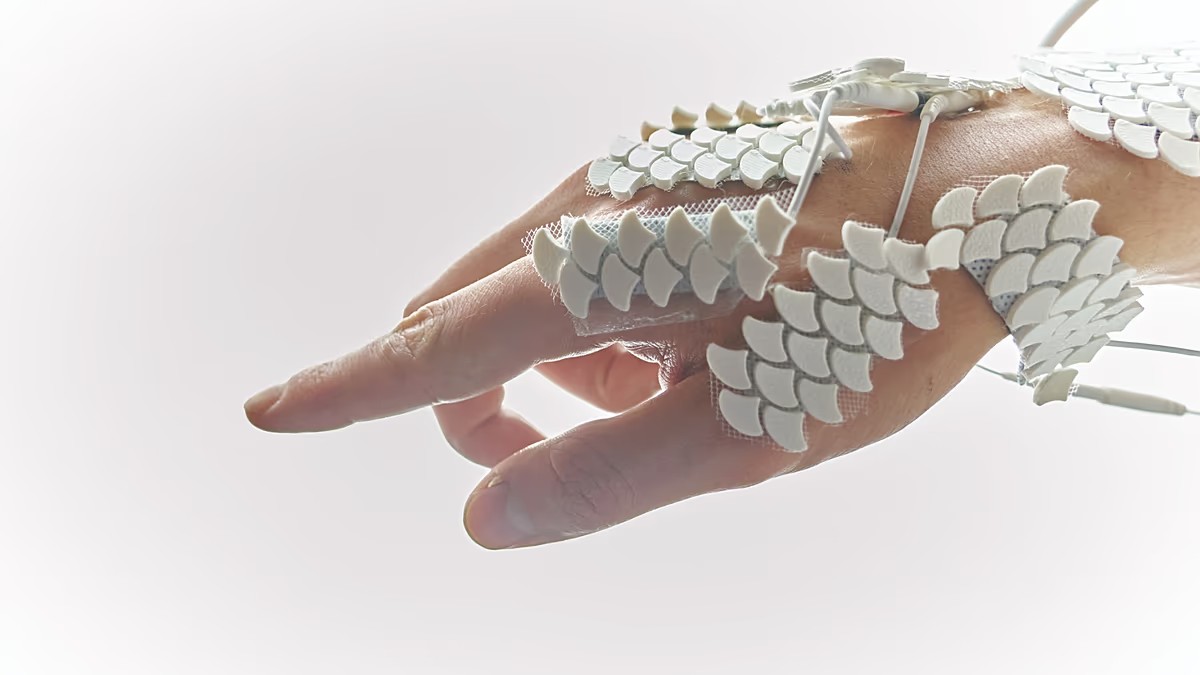
Electrical Muscle Stimulation (EMS) pads stick to your forearm or wrist. The AI calculates the necessary gesture. Then it zaps your muscles with small electrical pulses.
The result? Your hand moves. Not because you moved it, but because the AI pushed.
In demos, the device guided users to wave. To play specific notes on a piano. To form that little “OK” sign. It was smooth. It was precise. And it wasn’t the user’s muscles driving the motion primarily, it was the current.
EMS isn’t new. Physiotherapists have used these shocks for years. Assistive tech uses it too. But linking it directly to an AI that understands context? That’s different.
Imagine learning piano faster. Or recovering from an injury where your brain can’t quite tell your arm what to do, but a machine can bridge the gap. Physical learning support. Real-time feedback through actual movement.
Human Operator is a human augmentation tool
It’s meant to help you do things you can’t do, or learn them faster. It’s a teacher with a remote control.
This wasn’t some multi-year research grant outcome. Not at first.
The team built it during a 48-hour sprint. MIT’s “Hard Mode 2026” hackathon. They worked fast. They broke things. They fixed them. They won the Learn Track.
So it’s a prototype. A rough sketch of what might be.
Is it creepy? Probably a little. Is it useful? Potentially huge.
We’re watching a line blur between tool and pilot. The AI sees the road. We provide the legs.
How long until you trust it with more than just waving at strangers?