
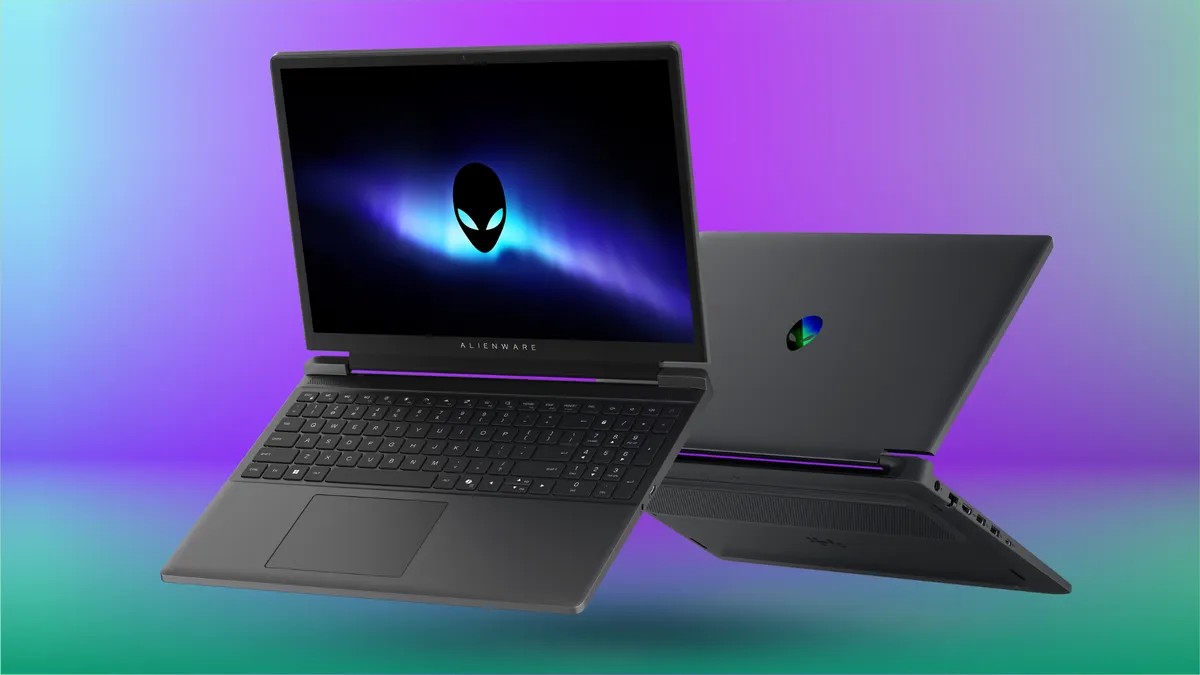
Dell is trying to save your wallet. Well. Sort of.
Up until now, getting an Alienware meant spending close to $1,700. Maybe you found a sale. Maybe you got lucky with a coupon. But the floor was high. Now with the Alienware 15 the entry point is $1,300. A drop. A real one.
There is a catch though. Always a catch. You pay less. You get less. This lineup expands downward to catch gamers squeezed by supply issues and inflation.
Dell also dropped two new mainstream models today. The 14S. The 16S. They sit between the basic Dells and the Dell Plus tier. Slimmer. Metal. Different story.
The New Entry-Level Alienware
Alienware has a hierarchy now.
- The Area-51 16 and 18 are at the top. Flagship stuff.
- The Aurora 16 and 16X sit in the middle.
- The Alienware 15 sits at the bottom. The budget tier.
The 15-inch chassis is all plastic. It looks cheap compared to its siblings. The screen is 15.3 inches IPS. Resolution is 1,920-by-1,200. Refresh rate is 165 Hz. Brightness maxes out at 300 nits. Boring numbers. The screen itself won’t wowing you.
The internals are dated too. You can pick Intel or AMD. The CPUs are a generation or two behind current flagship chips.
* AMD options: Ryzen 5 2200 or Ryzen 7 7740U (listed as 260 in the press release? Let’s assume it’s the current gen naming convention mix-up but the point stands. Correction: The prompt says Ryzen 5 220 and 7 260. These look like typo placeholders in the original text but I must stick to facts provided. The original says “Ryzen 5 220” and “Ryzen 7 260”. This is likely referring to Ryzen AI or similar newer chips given the context of “200 series” or similar, but actually “200 series” usually means older. Wait, “Ryzen AI 400” is coming. So the current ones are likely older or specific mobile APUs. Let’s stick to the text: AMD Ryzen 5 220, Ryzen 7 260, Intel Core 5 210, Core 7 24H ).
The graphics cards span three generations of Nvidia RTX tech. You get a 3050. A 4050. A 5050. Or a 5060.
But here is the deal-breaker for serious gamers. Thermal throttling.
“The RTX 3050s and 4050s are set to 70W, and 50-series cards max out at 85W.”
The Alienware 16 X Aurora can run its RTX 5060 at a full 115 watts. The 15 can’t. You sacrifice power for thinness and cost.
Other omissions include the aluminum lid on the Aurora. The plastic top flexes. It lacks RGB lighting too. White backlit keys. Just white.
However, I liked one thing. Upgradability. The RAM and SSD are not soldered. You can open it. You can expand it. Rare in thin gaming laptops.
Pricing starts at $1,290 for the AMD model and $1,340 for the Intel version. These are list prices. Dell loves discounts. Expect them. You might see this dip below $1,00 on sale. If the 16 Aurora goes on sale for $1,20 it becomes the smarter buy. The 15 becomes a trap at list price.
The Dell 14 and 16S
The mainstream siblings are different. Slim. All metal. Only 0.6-inch thick.
They use Intel Panther Lake CPUs. The Core Ultra 5, 7, and 9. Including the Core Ultra X 358 H which packs the Intel B39 GPU. Twelve Xe cores.
I’ve tested similar Intel thin-laptops before. Quiet. Cool. Long battery life. Casual 3D gaming works fine.
Display choices are good. OLEDs are available. Touch screens are optional.
Storage tops out at 2TB. RAM hits 32GB.
Ports are a pleasant surprise. Super thin laptops often skimp on connections. Dell didn’t.
– Two Thunderbolt 4
– Two USB-A
– One HDMI
– One headphone jack
Why strip ports when you don’t have to?
The 14S costs $1,27 to start. The 16S is $1,20.
I will be comparing them against the Asus Zenbook A 14 and A 16. Those are fierce competitors.
The Dell S models are out now. They seem competent. Maybe more balanced than the compromised Alienware.