
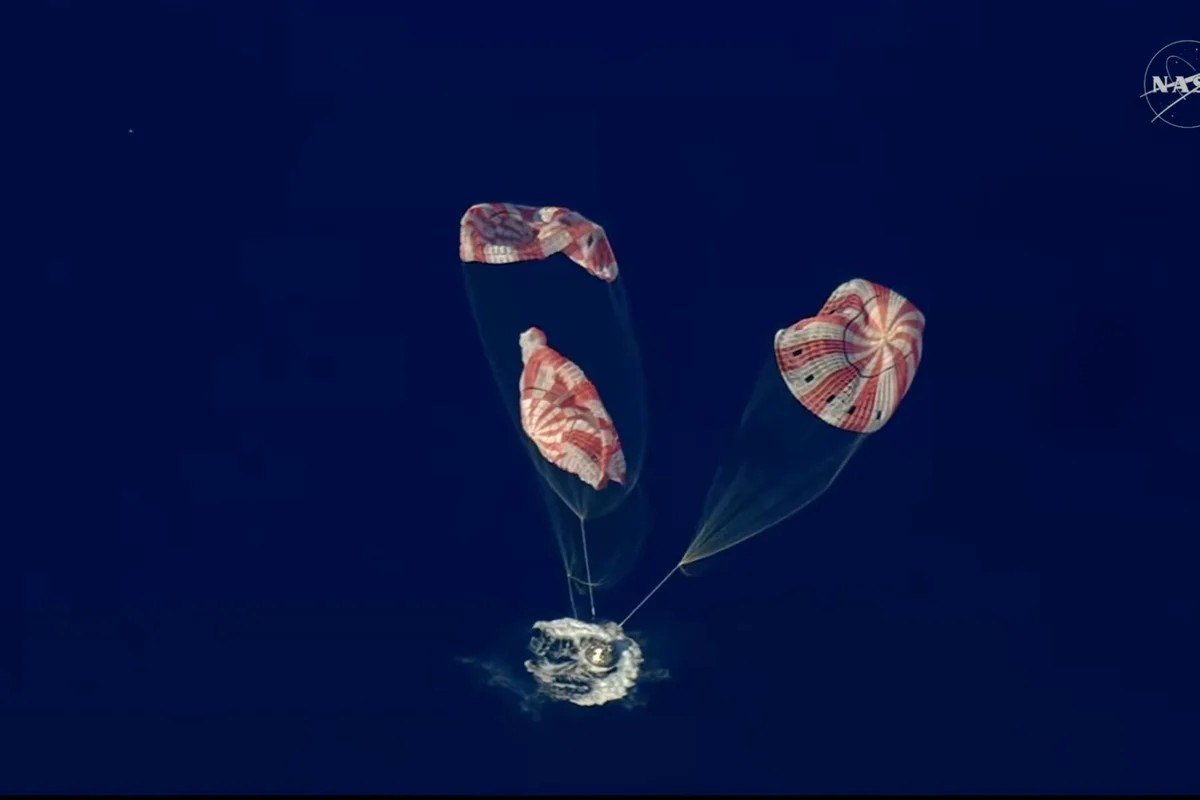
NASA’s Artemis II mission has officially concluded, with its four-person crew successfully splashing down in the Pacific Ocean. The mission marks a pivotal milestone in human spaceflight, proving that NASA can safely navigate crews around the Moon and return them to Earth, setting the stage for future lunar landings.
A High-Stakes Return to Earth
The reentry phase was one of the most critical moments of the mission. Traveling at 33 times the speed of sound, the Orion capsule—which the crew affectionately named Integrity —had to endure extreme temperatures while piercing Earth’s atmosphere.
The descent carried significant technical tension:
– Heat Shield Concerns: Following issues discovered during the uncrewed Artemis I mission, NASA engineers were wary of the heat shield’s integrity.
– Mitigation Strategy: Rather than a full redesign, NASA opted to adjust the spacecraft’s re-entry trajectory to minimize thermal stress.
– The Result: NASA confirmed the capsule achieved a “perfect descent,” safely delivering the crew to the recovery ship USS John P. Murtha off the coast of San Diego.
Breaking Records and Redefining Perspectives
While Artemis II did not land on the lunar surface, it achieved unprecedented milestones in human exploration:
– Distance Record: The crew reached a distance of 252,756 miles (406,771 km) from Earth, surpassing the record previously held by Apollo 13 and marking the farthest humans have ever traveled from our home planet.
– Visual Discovery: The crew documented the lunar far side and captured a total solar eclipse, providing rare visual data of the celestial environment.
– Historical Echoes: The mission produced imagery reminiscent of the legendary 1968 “Earthrise” photos from Apollo 8, specifically capturing “Earthset”—the sight of our blue planet disappearing behind the lunar horizon.
Navigating the Realities of Deep Space
The 10-day mission was not without its “growing pains.” As is common with pioneering technology, the crew faced several mechanical setbacks, including:
– Malfunctioning valves in both the drinking water and propellant systems.
– Persistent issues with the spacecraft’s waste management system (the toilet).
Despite these inconveniences, the astronauts maintained a resilient attitude. Crew member Christina Koch noted that the risks and technical hurdles are an inherent part of exploring deeper into space, framing these challenges as necessary sacrifices for scientific progress.
The Road to the Lunar South Pole
The success of Artemis II serves as a vital proof-of-concept for the next phases of the Artemis program, which aims to establish a sustainable human presence on the Moon.
The upcoming roadmap includes:
1. Artemis III (Next Year): Astronauts will practice docking the Orion capsule with a lunar lander while in Earth orbit.
2. Artemis IV (2028): A planned mission to attempt a crewed landing near the Moon’s south pole, a region of intense scientific interest due to its potential water ice reserves.
“It’s the first of many trips and we just need to continue on because there’s so much more to learn about the moon.” — Mission Crew
Conclusion
By successfully navigating record-breaking distances and technical complexities, Artemis II has transitioned NASA from theoretical planning to practical execution. This mission bridges the gap between the Apollo era and a future where humans live and work on the lunar surface.