
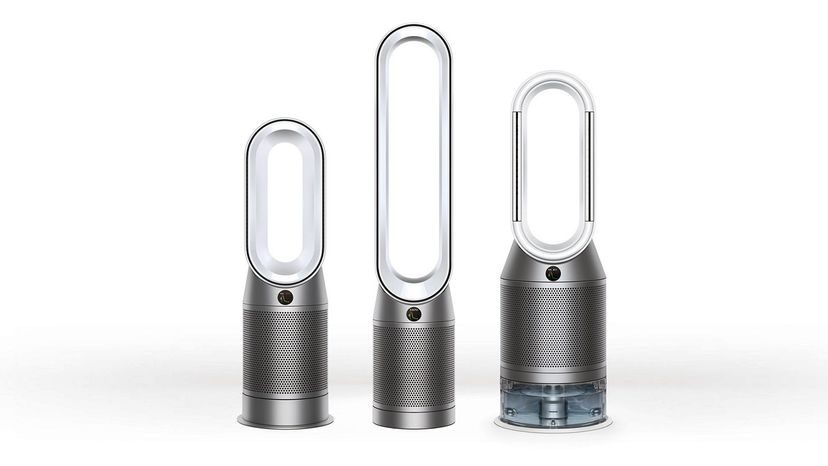
This started in October 2009. James Dyson, best known for his bagless vacuum cleaners, has introduced a new device: the Dyson Air Multiplier. At first glance it looks like a cheap rim. Low round tube at the bottom. There are no blades. No grill. Just smooth plastic.
It felt like a gimmick. This is a parlor trick for engineers with money. But this is not the case.
Dyson didn’t stop there. The selection has expanded. Now you have a water purifier. Humidifier. heater. All use the same “bladeless” technology. They clean the air. It hydrates you. It keeps your living room warm in winter. If you look at them, you will notice that nothing is moving. There is no rotating blade. No rattling cages.
So how do you feel?
Open it. Please stand in front of it. The air hits your face. Stable. comfortable. It shouldn’t work. Physics says otherwise.
This is reality. The magic happens at the bottom.
The hidden power of motors and induction
Take away the aesthetics and you find a brushless motor. Hidden inside the base. You can’t see it. You can’t touch it. But I’ll do my best.
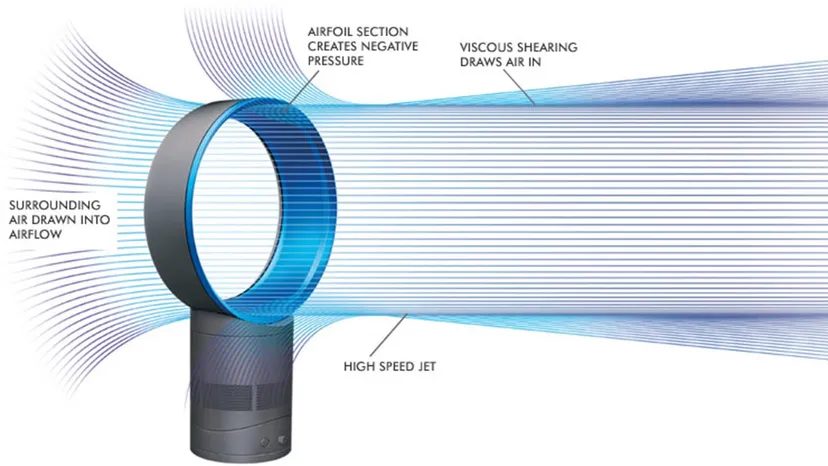
The motor sucks in air and pushes it into the hollow tire. Air flows inside this tube. Then I ran into a narrow opening. small opening. It is about 1 mm wide, maybe even smaller.
Air blows out of the slot at high speed.
This is interesting in science. Air just won’t come out of the holes. It’s about what happens next.
The Coanda Effect. It’s a word. Air moving through the gap at high speed sticks to the curved surface of the pipe. As you move along the curve, you draw air around you. Lets more air into the circuit.
The air blows out from the opening behind the tire. A low pressure area is formed. This area draws “more” air from the back of the unit.
result?
The Dyson Air Multiplier improves airflow. One air unit entering the base can move at least 10 air units away from the front. This is not magic. This is fluid mechanics. But that’s how it is.
Why stable air is important
Standard fans have blades. sharp edges. Rotate metal or plastic. Every time the blade cuts through the air, turbulence is created. Flurry. There was an explosion.
you know it. It’s uneven. It hits you, stops and hits you again.
Dyson systems do not have blades. No interruptions. The air is removed as a flat continuous plate. This is laminar flow.
“These devices produce a more consistent wind than standard fans with blades.”
There’s no talking. No wind spikes. It’s just a constant flow. For some people, this is annoying. For others, it is the only effect.
Has it become quiet? sometimes. The engine keeps buzzing. But you won’t hear the “whoosh” of the blade cutting through the air. It’s a different sound. Low area.
Is it more beautiful? not necessarily
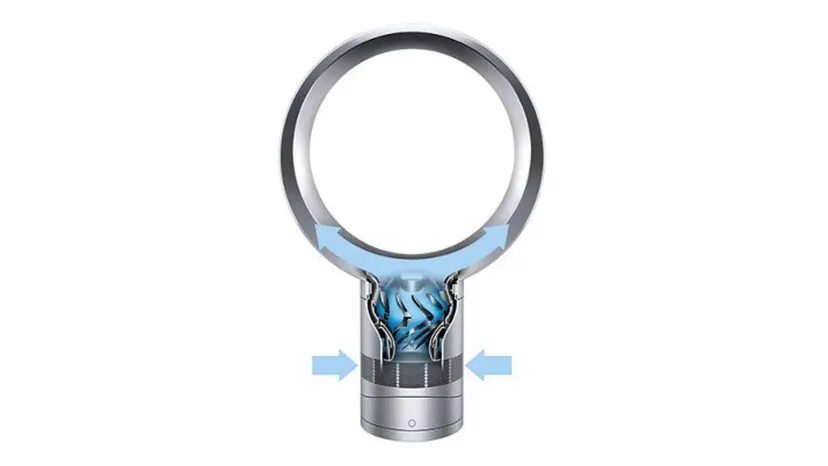
Let’s get the terminology right. Calling the Dyson Air Multiplier a “bladeless fan” is technically inaccurate. Blades are present but hidden inside the base unit. There is an electric motor at the base that uses nine asymmetric blades. These rotors draw air into the device, and Dyson says the latest model can pump more than 77 gallons of air per second.
But the magic isn’t just suction. It’s in what happens after the air enters the base.
The air flow is directed to the back of the machine. For those looking into how the Dyson Air Multiplier Fan works, the real question is simple. How does the device amplify the air output?
The answer can be found in fluid mechanics. Air is a gas, but gases follow the same physical laws as liquids when moving. The pressure drops as air is forced through the narrow gap in the circular ring to the front of the fan. This draws air into the pipe from behind the fan.
This phenomenon is called induction.
The high speed airflow pushes the air and the air behind the fan is pulled to fill the gap. At the same time, the air around the edge of the fan starts to move in the direction of the wind. This is called entrainment.
Dyson claims that by combining induction and entrainment, the fan produces 15 times more air than the motor can draw.
Why should the design be changed?
However, there is a problem. The first generation products have one particular technical hurdle that is still unresolved. This has nothing to do with airflow or cooling efficiency. It was about sound.
Producing such high power requires turbulent air movement, which causes noise. As consumers began using these devices in their bedrooms and quiet offices, acoustics became an issue. Dyson realized that the original design prioritized the addition of raw air over comfort decibels.
This limitation required a redesign. When Dyson launched the second generation Air Multiplier, they didn’t just improve the aesthetics. They re-engineered the internal airflow path to manage turbulence. The goal was to significantly reduce the mechanical whine and hiss associated with the original model, while maintaining the 15x amplification effect. The result is quieter operation without compromising the core promise of bladeless design.
The original Dyson Air Multiplier looked like a scene from a sci-fi movie, but sounded like a jet engine ready for takeoff. It’s noisy. Dyson knew this was unacceptable for high-end equipment, so they decided to address the noise issue with the second generation.
This is not a simple repair job. The company has invested more than 60 million dollars in research. They selected 65 engineers for this task. The team created 640 prototypes. They filed hundreds of patents. The goal was simple, but difficult. The purpose is to understand how air moves inside the fan and how this movement creates sound.
Seeing the Sound
This is due to turbulence. In the first version, the air sucked into the bottom bounced back chaotically. That chaos made noise. To find the exact source, engineers installed a fan in a soundproof room. Ten microphones listened for every whir and buzz.
They didn’t just listen. They visualize the problem. They built translucent prototypes. They ran ultraviolet paint and smoke through the device. High-speed cameras record video images frame by frame. This reveals where air can collect and wreak havoc.
Data shows that uncontrolled air movement is the enemy of silence.
The Helmholtz Solution
Engineers solved the turbulence problem by integrating a Helmholtz cavities into the fan.
If you’ve ever held a seashell to your ear or blown across the top of a glass bottle, you’ve probably heard this effect. Sound bounces off or slides off hard surfaces inside the cavity. Car manufacturers use these principles to reduce noise in exhaust systems. Dyson has incorporated this concept into their tabletop fan.
Helmholtz cavities naturally produces noise. However, if you understand how it works, you can control the noise. By adding certain cavities to the bottom, the engineers increased the air pressure. These cavities begin to act as silencers.
They tuned the chamber to mute sounds around 1,000 Hertz. This is the frequency range that people find most annoying. It’s a sharp, high-pitched whine that grates on nerves.
Results That Matter
The investment paid off. Dyson claims the second generation fans are 75% quieter than the first generation fans.
Thanks to the improved air flow, the motor didn’t have to work as hard. The air moved more smoothly through the entire device. So Dyson downsized the motor. The new version uses 40% less power.
In 2014, the Noise Abatement Society awarded this fan the Quiet Mark. This award recognizes products that reduce unnecessary noise pollution. This is a badge of honor for engineers who care about how their machines sound as well as how they look.
Beyond Cooling Air
The original Dyson Cool was just a fan. It moves air like a fan. However, the company has since expanded its range of air amplifiers to include more advanced products. Now you can buy devices with humidification, cleaning and cooling functions. Or one that heats, purifies, and cools. It’s not just about the wind anymore.
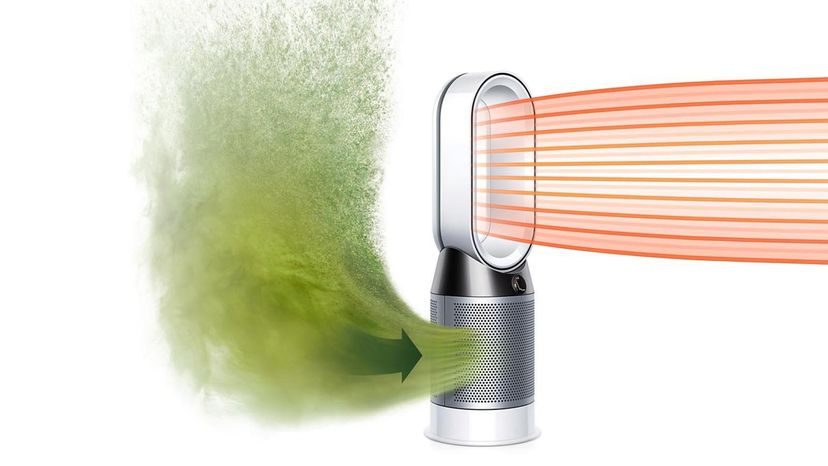
Many newer models have HEPA filters on the bottom. Dyson claims to capture 99.95% of pollutants. These include fine dust, allergens and formaldehyde. The result? The exhaust air is said to be 50% cleaner than the incoming air. It’s no longer just about moving stale air. It’s cleaning it.
Since we live in the 21st century, these devices can be well integrated into our digital lives. Most connect to the home Wi-Fi network. Many work with voice assistants. You can control the flow, heat or filtration with your phone or voice.
Innovation costs
All this technology doesn’t come cheap. Prices start at around $400 for a basic fan with an air purifier. Add heat? Add humidification? Beware of price increases. Some full-featured models cost close to $1,000.
Is it worth it? It depends on what you need. If you just need airflow without additional cleaning, the standard Dyson Cool Tower Fan (AM07) is the best choice. Skip the filter and save hundreds of dollars. But if you want to remove formaldehyde from your living room while you sleep, you’ll have to pay the price.
Can Dyson fans really cool the air?
Let’s clear up some common misconceptions. Dyson fans are not air conditioners. They don’t lower the ambient temperature of a room. They don’t remove heat from the air.
Instead, it creates a steady, smooth, amplified airflow. This draws heat away from the skin faster. The result feels cool. Basically, It’s wind chill, basically. However, a Dyson won’t replace your AC. It is more comfortable in hot weather, but the temperature of the room itself does not change.
Energy efficiency and safety
One of the advantages of air amplifiers is efficiency. These fans consume very little power. It won’t increase your utility bills like an old tower fan or a working air conditioner would.
There is also a safety factor. High-quality bladeless fans are quieter, more powerful and safer. There are no spinning blades to poke your fingers into. Just a sleek, modern object sitting in your living room. It looks good. Run quietly. it works.
How it really works
“Bladeless” is a bit of a misnomer. There are blades inside. They’re just hidden in the pedestal.
The motor rotates asymmetrically placed blades inside the pedestal. This draws air. The air then flows upwards up through a hollow channel in the stand and into the ring. The ring acts like a ramp. The air flows along the curved surface of the ring’s interior. It exits through slits on the back of the tube.
This design utilizes the Coandă effect. The movement of the air also draws in the surrounding air, which increases the air flow. It’s aerodynamics in a loop.
Which Dyson bladeless fan is the best?
If cleaning is required, choose a model with a HEPA filter. If you need warmth, look for the Hot+Cool series. If you only need air movement, AM07 is the most cost-effective option.
The technology is amazing. It is very stylish. It’s innovative. When it first launched, the blogosphere was buzzing. Now it’s just another device. But there is something better.
No one knows what the future holds. Maybe we’ll eventually stop using fans altogether. Or maybe you keep adding filters. For now, the Dyson Air Multiplier falls somewhere in the middle. cooler. Cleaner. Heater. A statement piece.