



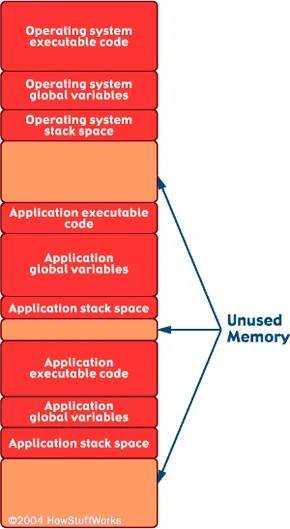
Your computer doesn’t just have RAM. It has a messy, fragmented, constantly shifting landscape of memory that the CPU pretends to be infinite. This is the reality of dynamic data structures running on modern hardware.
A typical workstation today sits on 16 to 64 megabytes of physical RAM. But don’t let those small numbers fool you. Through a technique called virtual memory, the system swaps data between that RAM and the hard disk. The CPU sees an illusion. It thinks it has 200 to 500 megabytes of contiguous space. The illusion works. The code runs. But when the OS has to dig into the hard drive to fetch a page of memory, everything slows down. You feel it in the lag. You feel it in the fan spin-up. Despite the performance hit, virtual memory is an inexpensive way to “expand” your RAM. It’s a necessary compromise.
Let’s assume a clean slate. A total memory space of 50 megabytes. No more. No less. This is the budget.
The operating system owns this 50-megabyte block. It divides the pie. Not equally. Never equally.
First, there is the code. The executable instructions for every application currently running, plus the OS kernel itself. This section is static. It doesn’t change while the program is alive. Next come the global variables. These are the shared constants and state flags that every part of the application can touch. They sit in memory from the moment the app launches until it dies.
Then there is the stack.
The stack is rigid. It grows and shrinks in lockstep with function calls. When you invoke a function, its local variables and parameters are pushed onto the stack. When the function returns, they are popped off. The stack remembers the call order. It ensures you return to the right place. But it has a maximum size. You cannot ask the stack for more memory mid-flight. If you try, the stack overflows. The program crashes.
When a program finishes, the OS unloads it. The code, the globals, the stack space—all of it is wiped clean. That memory is recycled. It’s ready for the next program.
But here is the problem. At any given moment, roughly 50 percent of that 50-megabyte space might be unused. Why? Because the stack only holds what is currently executing. The code only holds the instructions. The unused chunks of memory are scattered. They are holes.
The operating system takes these holes and groups them together. It calls this collective pool the heap.
This is where dynamic allocation happens. The heap is the only place in memory where a program can ask for an exact amount of space, precisely when it needs it. You don’t declare an array of 1000 integers at compile time. You don’t know if you’ll need 1000 or 100,000. You wait. You run the code. You decide you need that space. Then you call malloc.
malloc stands for memory allocate. It grabs a block from the heap. It returns a pointer. You use that pointer. When you are done, you call free. The block goes back into the pool.
This is the fundamental difference between static and dynamic memory. The stack is automatic. It is tied to scope. The heap is manual. It is tied to intent.
Why does this matter to you? Because most bugs in complex software don’t come from bad logic. They come from bad memory management. If you allocate from the heap and forget to free it, you leak memory. The heap shrinks. Eventually, the system runs out of space. Programs freeze. The OS kills processes. You lose unsaved work.
Conversely, if you try to allocate too much on the stack, you blow the stack limit. The program terminates abruptly.
The heap allows for flexibility. It allows for data structures that grow. Linked lists. Trees. Graphs. None of these can be defined at compile time with a fixed size. They must be built on the fly. They must live in the heap.
Is the heap perfect? No. It fragments. As you allocate and free blocks of different sizes, the heap becomes a jigsaw puzzle with missing pieces. Finding a contiguous block of free memory can become slow. This is why malloc can sometimes take a noticeable amount of time. It has to search. It has to coalesce. It has to manage the chaos.
But without the heap, modern computing collapses.


