



The climate crisis has reached a critical juncture. Despite slowing growth in greenhouse gas emissions, the world is on track to exceed the 1.5°C warming threshold. Simply reducing emissions is no longer sufficient; actively removing carbon dioxide from the atmosphere is now essential – a reality underscored by the latest UN climate reports. The challenge is immense: scaling carbon capture technologies to extract roughly 9 billion metric tons of CO2 annually.
One emerging solution involves extracting carbon directly from the ocean, an approach that sidesteps some of the controversies surrounding other geoengineering proposals. Unlike methods like solar radiation management, ocean-based carbon removal doesn’t introduce new substances into the environment, instead tackling existing pollution. In 2023, hundreds of scientists called for accelerated research and testing of this technique, citing both climate benefits and the potential to mitigate ocean acidification – a byproduct of excessive CO2 absorption that threatens marine life.
The Science Behind Ocean Carbon Removal
Extracting carbon from seawater is more efficient than capturing it from the air. Atmospheric CO2 concentration is roughly 430 parts per million, requiring massive volumes of air to yield a single ton of carbon. In contrast, the ocean holds approximately 150 times more concentrated CO2 due to its chemical properties; about 30% of human emissions are already absorbed by marine environments.
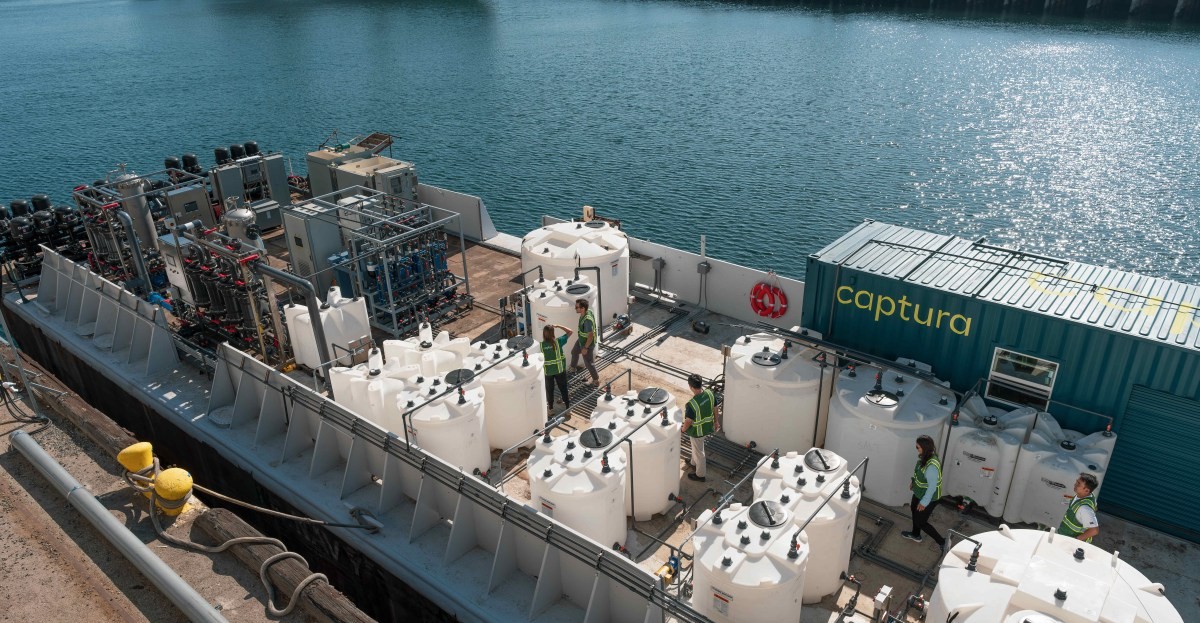
Companies like Equatic and Captura are pioneering electrochemical methods to separate seawater into acids and bases, extracting CO2 while maintaining a closed-loop system. The removed carbon is then recombined with remaining water to return it to the ocean, creating space for new CO2 absorption. Captura’s technology even incorporates a battery-like function, storing energy during electrolysis for later use, making it compatible with intermittent renewable power sources.
The scale of this undertaking is significant. To remove 10 gigatonnes of global greenhouse gases annually, roughly 20,000 commercial-scale plants similar to Captura’s pilot unit in Hawaii would be needed. Despite this, the infrastructure requirements are less daunting than building entirely new facilities, as many coastal regions already possess the necessary pipelines, power grids, and technical expertise from existing industries like shipping and oil extraction.
The Business of Carbon Removal
Despite technological progress, the viability of ocean-based CO2 removal as a business remains uncertain. Current economic incentives are weak. Without robust regulations or carbon pricing mechanisms, companies struggle to secure customers willing to pay for emissions offsets. The US 45Q tax credit excludes marine CO2 removal, and corporate sustainability initiatives face headwinds in a shifting political landscape.
However, several factors could shift the market. Voluntary carbon markets, driven by corporations anticipating future restrictions, may create demand. The Frontier consortium, backed by companies like Google and JPMorgan Chase & Co, has committed $1 billion to purchase carbon removal credits, signaling long-term interest. Additionally, some governments are exploring cap-and-trade systems that could integrate ocean CO2 extraction into existing emissions reduction schemes.
Companies are also diversifying revenue streams. Captura is licensing its electrodialysis technology for applications beyond CO2 capture, such as desalination and lithium mining. Equatic aims to sell byproducts like hydrogen, further enhancing profitability.
The Future of Marine Carbon Extraction
Ocean-based CO2 removal isn’t a standalone solution but one piece of a broader toolkit. To meet climate goals, we must aggressively decarbonize all sectors while deploying various carbon removal technologies – including direct air capture, enhanced rock weathering, and alkalinity enhancement.
The success of marine CO2 extraction hinges on continued innovation, cost reduction, and policy support. The current environment is challenging, but if these firms can survive, scale, and prove long-term viability, they could emerge as key players in the fight against climate change.
Ultimately, the feasibility of reversing decades of carbon emissions remains unclear. However, given the scale of the existing planetary experiment, a more thoughtful approach to managing this crisis is not just desirable but necessary.


