
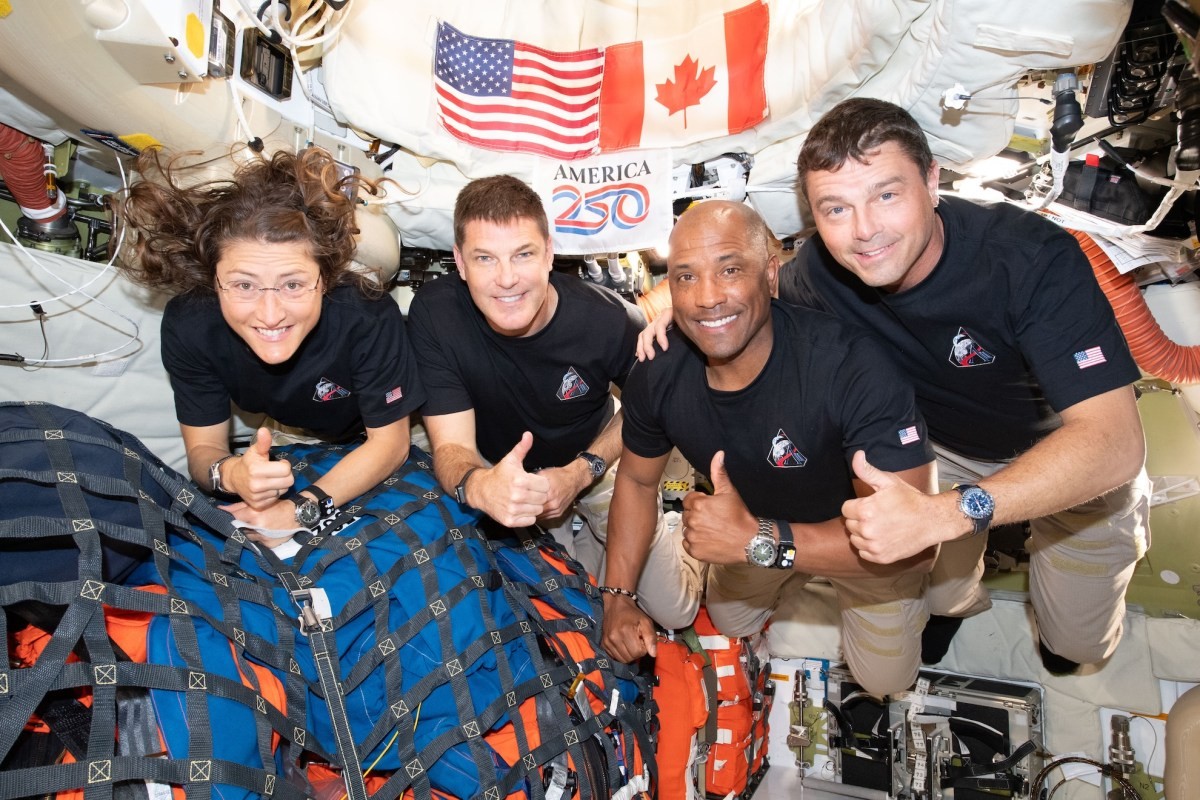
The crew of NASA’s Artemis II mission has successfully returned to Earth, marking a historic milestone in human space exploration. The Orion spacecraft, named Integrity, splashed down safely in the Pacific Ocean off the coast of San Diego at 5:07 p.m. PT, following a nine-day journey around the Moon.
A Successful Return to Earth
All four crew members—Commander Reid Wiseman, pilot Victor Glover, and mission specialists Christina Koch and Jeremy Hansen —were reported to be in excellent health following the landing. The mission, which included three Americans and one Canadian, is being hailed by NASA officials as a “perfect” execution of deep-space operations.
The mission’s success is a significant technical achievement. Returning from lunar orbit requires much higher speeds and more intense atmospheric re-entry than missions to the International Space Station, making the “perfect” splashdown a testament to the spacecraft’s design and the crew’s precision.
Breaking Records and Exploring the Lunar Frontier
Artemis II represents the first time humans have ventured into lunar orbit in over half a century. During the mission, the crew reached distances of approximately 252,760 miles from Earth, setting a new benchmark for human travel.
Beyond the technical feat of navigation, the mission provided unprecedented scientific and observational value:
– New Lunar Data: The crew captured high-resolution imagery of previously unseen lunar surfaces, identifying new craters.
– Celestial Events: The astronauts were able to witness a total solar eclipse from space, providing a unique vantage point for astronomical study.
– Personal Legacy: In a poignant moment of scientific discovery, the crew named a newly identified crater after Carroll Wiseman, the late wife of Commander Reid Wiseman.
The New Era of Space Exploration
The successful completion of Artemis II signals more than just a single mission’s end; it marks the resurgence of human presence in deep space. NASA Administrator Jared Isaacman, a figure bridging the gap between government and commercial spaceflight, described the crew as “ambassadors to the stars.”
This mission serves as a critical proving ground for the upcoming Artemis III mission, which aims to land humans on the lunar surface. By successfully navigating the complexities of long-duration lunar orbits and high-speed re-entry, NASA has demonstrated that the infrastructure for a sustained human presence on and around the Moon is now operational.
“I can’t imagine a better crew. It was a perfect mission.” — Jared Isaacman, NASA Administrator
Conclusion
The Artemis II mission successfully validates the technology and human capability required for deep-space travel, effectively reopening the door to lunar exploration and paving the way for future landings on the Moon.