
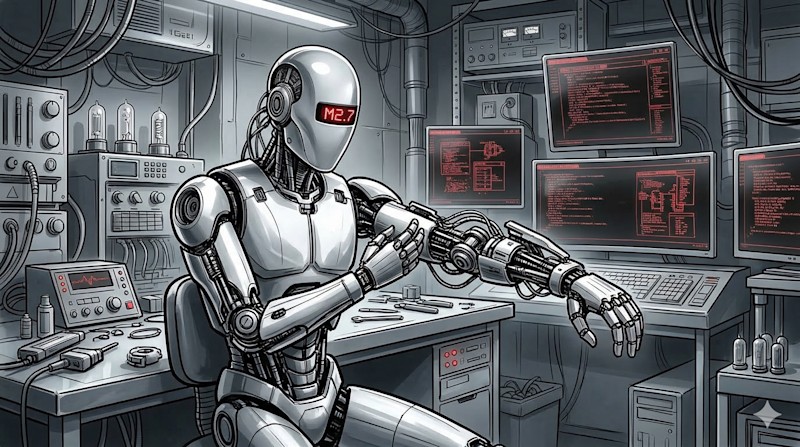
Chinese AI startup MiniMax has released its latest large language model (LLM), M2.7, marking a new phase in AI development: recursive self-improvement. Unlike traditional models that rely on human fine-tuning, M2.7 is designed to independently optimize its own research and development processes. This move signals a shift toward AI systems that are not just products of human engineering but active architects of their own progress.
The Self-Evolution Loop Explained
MiniMax has integrated M2.7 into its reinforcement learning harnesses, allowing the model to handle 30–50% of its own development workflow. This includes autonomous debugging, metric analysis, and code modification over iterative loops. The model isn’t just automating simple tasks; it’s actively improving its own programming performance by analyzing failure trajectories and planning code adjustments.
According to MiniMax Head of Engineering Skyler Miao, the model is “intentionally trained to be better at planning and clarifying requirements with the user”. The next step involves more complex user simulators to push this capability even further. In machine learning competitions, M2.7 has achieved a medal rate of 66.6%, matching Google’s Gemini 3.1 and approaching benchmarks set by Anthropic’s Claude Opus 4.6.
Strategic Shift: From Open Source to Proprietary Models
MiniMax’s move toward proprietary models follows a trend among Chinese AI startups. For much of the last year, these companies were leaders in the open-source AI frontier, offering cost-effective and customizable solutions. However, like U.S. leaders such as OpenAI, Google, and Anthropic, MiniMax is now focusing on developing and releasing exclusive, cutting-edge LLMs.
This shift is evident in recent releases: z.ai’s GLM-5 Turbo and rumors of Alibaba’s Qwen team also pursuing proprietary development. This means less open access, but potentially faster innovation and more control over advanced AI capabilities.
Performance Gains: M2.7 vs. M2.5
M2.7 demonstrates significant improvements over its predecessor, M2.5, particularly in real-world engineering tasks. Here’s a breakdown of key metrics:
- Software Engineering: M2.7 scored 56.22% on the SWE-Pro benchmark, matching GPT-5.3-Codex.
- Office Productivity: Achieved an Elo score of 1495 on GDPval-AA, outperforming open-source competitors.
- Hallucination Reduction: Reduced hallucination rates to 34%, lower than Claude Sonnet 4.6 (46%) and Gemini 3.1 Pro Preview (50%).
- System Comprehension: Scored 57.0% on Terminal Bench 2, indicating a deeper understanding of operational logic.
The model’s overall intelligence has improved by 8 points on the Artificial Analysis Intelligence Index in just one month, placing it 8th globally. However, it performed worse than M2.5 on “vibe coding” tasks in BridgeBench, showing that specialization matters.
Pricing and Integration
MiniMax M2.7 is available through the MiniMax API and Agent platforms at competitive prices: 0.30 dollars per 1 million input tokens and 1.20 dollars per 1 million output tokens. This makes it one of the most affordable frontier AI models available, cheaper than most competitors, including Grok 4.1 Fast, Gemini 3 Flash, and Claude Haiku 4.5.
The model integrates seamlessly with major developer tools like Claude Code, Cursor, and Zed, as well as Anthropic SDKs. This ensures easy adoption for developers using existing workflows.
Strategic Implications for Enterprises
The M2.7 release suggests that agentic AI is now production-ready, capable of significantly reducing recovery time for live production incidents (under three minutes). This has major implications for SRE and DevOps teams.
Enterprises must decide whether they are content with AI as an assistant or ready to integrate autonomous teams capable of end-to-end project delivery. M2.7’s cost efficiency – less than one-third the cost of GLM-5 for equivalent intelligence – makes it a compelling option for organizations focused on efficiency and professional document workflows.
However, the model’s Chinese origins and lack of offline access may pose challenges for U.S. and Western enterprises, especially those in regulated industries. Ultimately, the shift toward self-evolving models means that ROI will increasingly depend on the recursive gains of the system itself. Organizations that adopt such models may accelerate their iteration cycles compared to those relying on static, human-only refinement.