



You probably already know that an audio/video receiver acts as the brain, extracting the digital audio hidden in the video signal and transmitting its power to the appropriate speakers. However, the problem is that not all receivers speak the same language. “Language” is called formats. Currently, the market is essentially a showdown between two giants: Dolby Laboratories and Digital Theater Systems (DTS).
Dolby offers the Dolby Digital and Dolby Pro Logic families. DTS offers its own series of DTS Digital Theater Sound formatsats. The list of options can be overwhelming. Let’s cut through the noise and see what’s really important to your setup.
Compression difference
When you ask, “Which surround sound formatsat is better?” the answer usually comes down to compression. DTS encoding provides less compression than Dolby encoding. Less data packed into a smaller space means fewer artifacts. The result? DTS sounds are generally clearer, sharper and more detailed.
But there are also compromises. DTS is less common in DVD and TV broadcasts. Most discs have a Dolby sound option. Some discs offer DTS as a bonus track, but you have to look for it. If you primarily watch broadcast TV or standard DVDs, Dolby is a safer choice for compatibility. If you have a high-end Blu-ray collection, you might want to look for more DTS.
Speaker configuration: 5.1, 6.1, 7.1
When buying a receiver, there are two things you need to decide. First, do you care about DTS support? Second, how many speakers do you want in your room?
Industry standards focus on the number of channels. 5.1, 6.1, 7.1 are displayed. “.1” is not a decimal point. Represents the subwoofer channel. The subwoofer handles low-frequency effects. The explosion turned into a chest rumble, causing the train to rumble violently. Without this, the action scenes would feel flat.
Here is how the common setups break down.
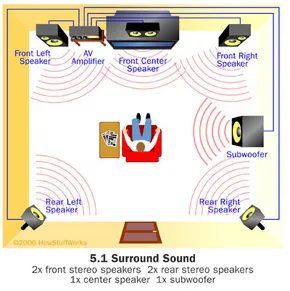
5.1 surround sound
This is the starting point. You get five speakers and a subwoofer. The front speakers have a simple layout: left, center and right. The left and right surround speakers are placed at the back or side.
Most receivers can handle this easily. Dolby Digital, Dolby Pro Logic II and DTS 5.1 all support this configuration. Also included is DTS 96/24, which uses a 5.1-channel formatsat to reproduce the audio at the same sample rate at which it was recorded. Accuracy is maintained, but corresponding source material is required.
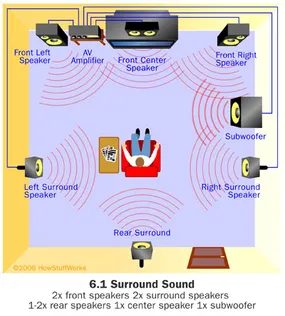
6.1 Surround Sound
This setup is based on 5.1 with the rear channel added. You should now see 6 or 7 speakers and a subwoofer. The question is where to place the additional speakers.
Dolby Digital EX splits one additional channel between the left and right rear speakers. Create a wider rear wall of sound. DTS-ES takes a different approach. It places a single rear center speaker. When it is attached to the center of the back, it is easier to identify sounds coming from behind. DTS Neo:6 also supports 6-channel formatsats, typically creating a simulated rear channel from a stereo source.
You need to look at your room. Do you have room for speakers behind your couch? Or Do you need a enveloping wrap of side and rear speakers? Your choice of layout determines your physical layout. The layout determines the immersion.

Differences in rear channels
Most people think of surround sound as just volume. it is not. It’s all about placement.
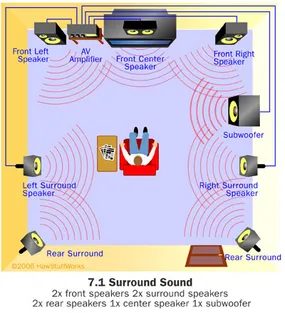
Let’s take Dolby Pro Logic IIx as an example. The 7.1 setup is the game changer here. Why? This is because separate channels have been assigned to the left and right rear speakers.
Older systems usually split a single audio signal between two rear speakers. They share the burden. They skimp on details.
Dolby Pro Logic IIx does not do this. Send different data to the left and right rear. Independent. Precise.
This is more than just a specification update. This is the clarity of the space. You can hear what’s going on behind you without the confusion of dual signals. The sound field expands. The immersion deepens.
Which setting sounds better? The one that knows exactly where you are in the room. Or the one that guesses.

电视迎来了它的时刻
音频是驱动家庭影院的引擎,但说实话。 当你走进房间时,你的眼睛会直视屏幕。 电视是核心。 这是你首先注意到的事情。 扬声器只是在后台完成其工作,直到您真正聆听它们为止。
现在,我们来谈谈玻璃。
设置中的屏幕
我们正在进入有关电视的部分。 它们不仅仅是图片盒。 它们是整个体验的支柱。 但在您花钱购买 65 英寸的巨兽之前,请考虑一下它的声音。 或缺乏。
DIY Surround Sound
You don’t need a bank loan to get a decent surround sound experience. If you don’t have the money, you can install four speakers yourself. Yes, there are four. It works if you feed it a normal stereo signal. It’s not Dolby Atmos, but it resonates throughout the room.
The trick lies in the wiring and placement. Separates the left and right channels, creating a sense of space. It’s a hack. That’s smart. For more information on using surround channels using this method, check out our dedicated guide on using surround channels. It’s not about buying the most expensive receiver. It’s about understanding how signals work.
Define your own surround sound setup using 4 speakers and a standard stereo signal.
It’s raw. It’s functional. It’s better than listening to a stereo soundbar that promises the world but produces a flat picture. The TV shows landscapes. The four-speaker rig gives you the space.


